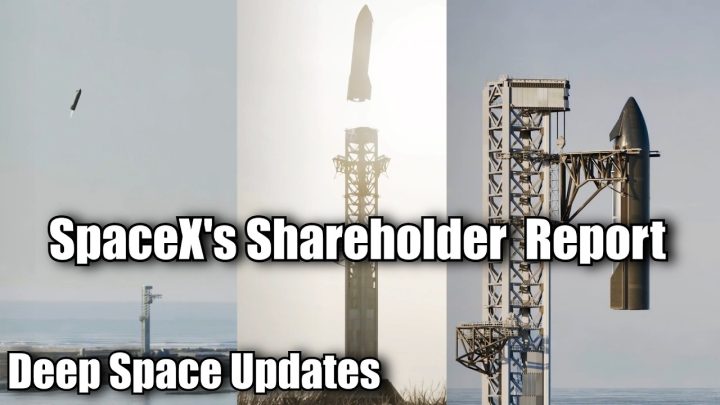
SpaceX has caught its Super Heavy boosters out of the sky with the launch tower’s mechanical arms. Now it is preparing to do the same with the Starship spacecraft itself — and this week’s activity at Starbase shows how methodically the company is building toward that moment. In the latest Avid Space weekly update, the recovered Ship 40 arrived back at the build site for its first major post-flight inspection, Booster 23 moved through testing while Booster 24 and Ship 44 continued construction, and SpaceX’s regulatory filings revealed an ambition far larger than any single flight. The company has asked to launch Starships from Starbase at a rate approaching twenty times its current allowance. Catching the ship is the technical key that makes such numbers conceivable.
The centrepiece of the week is a spacecraft that has already made history the slow way. Ship 40 is the first Starship upper stage to survive a flight, splash down in the ocean and be recovered, and its journey home took roughly three months. What engineers learn from it now — how its heat shield, Raptor engines and avionics actually weathered a real flight — is the data set on which the catch attempt, and everything after it, will be built. A caught ship returns to the tower in minutes. A splashed-down ship returns, if it returns at all, by sea, by road and by crane, months later and salt-soaked.
Ship 40’s Long Way Home
The recovery itself was an operation SpaceX had never attempted with a Starship. After splashdown, the 52-metre spacecraft was towed through open ocean for 24 days in rough seas that at times threatened the whole effort — Elon Musk publicly doubted it would succeed. The ship eventually reached calmer waters near Christmas Island, an Australian territory in the Indian Ocean, where engineers boarded it, inspected the vehicle and took samples from its heat shield for early analysis. It was then loaded aboard Forte, a large semi-submersible transport vessel, for the long voyage to Texas. Forte arrived at the Port of Brownsville on October 7, and SpaceX hauled the ship overland to Starbase, raised it vertical and moved it into the Megabay alongside three other Starships awaiting flight.
That odyssey is precisely why the catch matters. Every recovered ship teaches SpaceX how its thermal protection system performs across a full flight profile, knowledge no simulation fully replaces. But ocean recovery is slow, risky and effectively unscalable — a production line cannot wait a season for each returning vehicle. Ship 40’s inspection will feed design changes into the ships now on the line, including Ship 44. It may also be the last of its kind: if the tower catch works, future ships will come home the way the boosters already do, descending into the arms of the launch mount they left from.
Flight 15 and the First Catch Attempt
The next flight is where preparation meets attempt. Musk has said Flight 15 is targeted for a little before Thanksgiving, and that it could include the first attempt to catch a returning Starship with the launch tower’s arms, provided the vehicle and its systems are ready. SpaceX has announced no official date, and catch attempts in this programme have a history of slipping when conditions or hardware argue for caution. The booster half of the manoeuvre is proven — Super Heavy has been caught repeatedly — but the ship is a different problem. It returns from orbital velocity through a full re-entry heating profile, and must arrive at the tower with its structure, engines and control surfaces intact enough to be grabbed by two steel arms with no margin for a miss.
Meanwhile the production line is not waiting for the verdict. Booster 23 is in testing, with Booster 24 and Ship 44 in construction behind it, a cadence that reflects SpaceX’s build-many, fly-many philosophy. Vehicles are being completed faster than they can be flown under current permissions, which is the real context for the week’s other headline. A factory that outproduces its launch licence will eventually stall. SpaceX’s filing is designed to make sure it never does.
456 Launches a Year: The FAA Filing
On October 14, the Federal Aviation Administration published a Notice of Intent to prepare a Programmatic Environmental Impact Statement for SpaceX’s proposed expansion at Starbase — and the numbers are startling. SpaceX is seeking approval for up to 456 Starship launches and 912 landings per year, against the 25 launches and 50 landings currently authorised. The landings figure is double the launches because both halves of the system, booster and ship, are meant to return to the launch site on every flight. The proposal would ramp in two phases: first up to 100 launches and 200 landings annually, then the full 456 and 912, with operations permitted at any time Monday through Friday.
The review will not be quick, and it will not be quiet. A programmatic environmental statement is the FAA’s most comprehensive process, with a public scoping period and public meetings, and it will weigh noise, wildlife, airspace and community impacts along the South Texas coast. Musk has spoken of flying Starship hourly within two or three years; the filing is what turning that rhetoric into a permitted operation actually looks like. Even Phase 1 alone — a launch roughly every three to four days — would transform Starbase from a test site into something resembling a spaceport with an airline’s tempo. Approval deep into 2027 or beyond would still leave SpaceX licence-limited long after its hardware is ready, a tension worth watching.
Why the Catch Is the Whole Ballgame
Strip away the week’s individual headlines and a single logic connects them. A Starship system in which both stages are caught at the tower, inspected and flown again is the only version of the programme that can support hundreds of flights a year, Mars cargo campaigns or the orbital-refuelling architecture NASA’s lunar plans depend on. Ship 40’s three-month sea voyage is the counterexample — heroic, informative and utterly incompatible with that future. Booster 23’s tests, Ship 44’s construction and the FAA’s new review are all, in their own way, preparations for scale. The moment a ship first settles into the tower’s arms, Starship stops being an experiment in recovery and becomes a transport system. SpaceX is gearing up for exactly that moment, possibly within weeks.