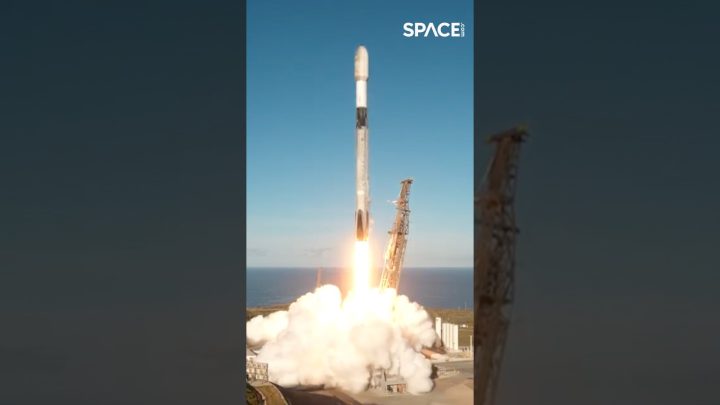
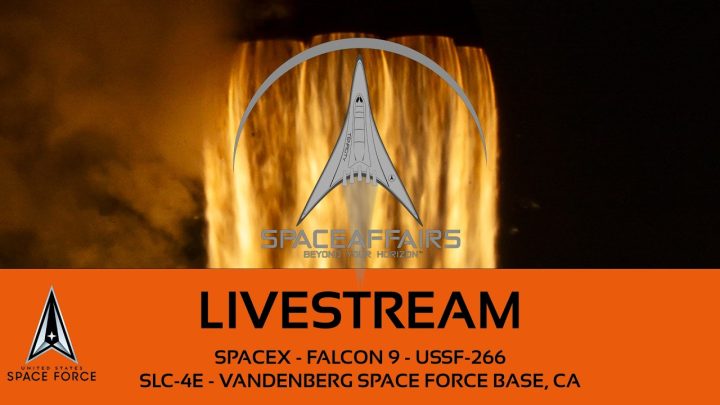
SpaceX launched a Falcon 9 rocket carrying the classified USSF-266 mission for the U.S. Space Force from Vandenberg Space Force Base in California on Nov. 24, 2026. The rocket lifted off from Space Launch Complex 4E at 11:08 a.m. EST, which was 8:08 a.m. PST and 1608 GMT, carrying a classified payload toward orbit. It was the third classified mission from California in just four days, and it was the fifth U.S. government launch by SpaceX in November. The first-stage booster, B1081, made its 29th flight, and it returned to the Pacific Ocean, landing aboard the drone ship “Of Course I Still Love You.”
The mission is short to describe and hard to explain in full, because its payload is classified, and the Space Force does not publish the details of what it carries. What can be said with confidence is the outline: a Falcon 9, a launch from Vandenberg, a classified payload, and a booster that flew for the 29th time and landed at sea. The rest of this article puts that outline in context, looking at the launch site, the booster, the pace of launches in November, and the limits of what a classified mission can tell the public.
A classified launch from Vandenberg
Vandenberg Space Force Base is on the California coast, and it is the main launch site for missions that need to reach polar orbits and other high-inclination paths. Space Launch Complex 4E is the pad used by SpaceX at Vandenberg, and it has become a regular site for Falcon 9 launches, including government missions. A launch at 8:08 a.m. local time is a morning launch for the base, and it is a routine time for a mission that has been planned for weeks. The rocket itself was a Falcon 9, the workhorse of SpaceX, and it carried a classified payload for the U.S. Space Force, which is the part of the mission that is not described in public.
The classification of the payload means that the public account of the mission is limited to the launch itself, and to the parts of the flight that can be seen from the ground or tracked in public. The name USSF-266 identifies the mission as a Space Force flight, and the number shows that it is part of a long series of such missions, but it does not say what the payload does, or what orbit it is heading for. It is a sign that the mission is part of a programme whose details are kept from the public, and that the launch is the only part that can be reported in full.
Booster B1081 and its 29th flight
The first stage of the Falcon 9, known as B1081, made its 29th flight on this mission, and that number is a story in itself. A rocket booster that flies 29 times is a long way from the early days of spaceflight, when a first stage was used once and then thrown away. Each flight adds to the record of that booster, and each landing adds to the evidence that a first stage can be recovered, checked and flown again.
After the launch, B1081 returned to the Pacific Ocean and landed aboard the drone ship “Of Course I Still Love You,” which is one of SpaceX’s sea-going landing platforms. A drone ship landing is a normal part of a Falcon 9 flight from Vandenberg, because the booster does not always have enough fuel to return to land, and a ship in the Pacific can be placed where the booster needs to land. The landing is a test of the booster, the ship and the guidance system, and a successful landing means that the booster can be brought back to port, checked and prepared for another flight. That is the point of reuse, and it is why the landing is reported as carefully as the launch itself.
A busy November for SpaceX and the Space Force
The mission was the fifth U.S. government launch by SpaceX in November, including four for the Space Force and one for the National Reconnaissance Office, and that pace is worth noting. Five government launches in a single month is a high rate, and it shows how much of the U.S. government’s space work is now done by SpaceX, and how often Falcon 9 is used for it. The four Space Force launches in that count include USSF-266, and the fifth was for the National Reconnaissance Office, which is the agency that runs the country’s spy satellites. Together, they show a month in which government launches were a regular event, rather than a rare one.
The pace also matters because it was the third classified mission from California in just four days, which is a short period for three such launches. A launch rate like that depends on more than a single rocket, because it needs pads, crews, range support and a supply of boosters that are ready to fly. It also depends on a system that can turn a pad around quickly, and on a launch provider that can fly often without a long pause between missions. The fact that SpaceX could do that in November, and that the Space Force could plan three classified missions from the same state in four days, is a sign of how routine government launches have become, and how much the launch business has changed in recent years.
What a classified mission can and cannot tell us
A classified mission is, by its nature, a story with a missing centre, because the payload is the part that matters most, and it is the part that is not described. The public can see the rocket, the launch time, the pad and the booster, and it can count the launches in a month, but it cannot see what the payload does, or what it is for. That is a limit that has to be accepted, and it is a limit that applies to every classified launch, not just to USSF-266. The mission can be judged on what is public: it launched on time, it carried its payload toward orbit, and its booster landed safely at sea.
The wider meaning of the mission is therefore not in the payload, but in the pattern that surrounds it, and that pattern is clear from the facts that are public. SpaceX is launching often for the U.S. government, the Space Force is using Falcon 9 for classified missions, and boosters like B1081 are flying many times and landing at sea. The USSF-266 mission will be remembered as one more flight in a busy month, and as the 29th flight of a booster that has become a familiar part of the Falcon 9 fleet, rather than as a single launch on its own.