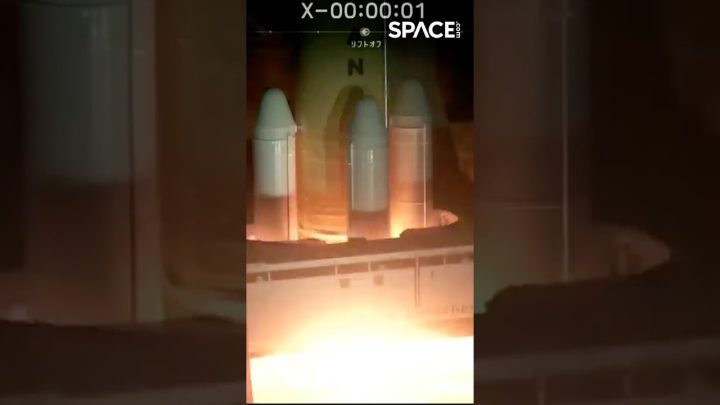
Japan has launched one of the most ambitious planetary missions ever attempted: a round trip to the moons of Mars to bring a piece of Phobos back to Earth. The Martian Moons eXploration spacecraft, known as MMX, lifted off aboard an H3 rocket from the Tanegashima Space Center at 4:41 a.m. local time on October 20 — 19:41 GMT on October 19 — and separated on its trajectory toward the Mars system about 71 minutes later. If the mission succeeds, it will return the first material ever collected from the Martian system, with the sample capsule due to land in Australia in 2031. No space agency has ever landed on Phobos and brought part of it home. Japan, which has already returned samples from two asteroids, now intends to do it at Mars.
The Strangest Little World in the Solar System
Phobos is a lumpy, potato-shaped moon barely 22 kilometres across, orbiting Mars so closely that it circles the planet faster than Mars itself rotates. It is also slowly spiralling inward, and will one day either break apart into a ring or crash into the surface below. Despite decades of Mars exploration, Phobos and its smaller companion Deimos — just 12.4 kilometres wide — remain among the least explored bodies in the solar system, known mostly from flyby photographs rather than extended study. The central mystery is where they came from, and it has divided scientists for generations. Phobos may be a captured asteroid, pulled in by Martian gravity long ago. Or it may be rubble blasted off Mars itself by a giant ancient impact, which later clumped back together in orbit.
That question cannot be settled by telescopes or orbiters alone, because the two theories predict different chemistry in the moon’s material. A captured asteroid should look like primitive carbon-rich rock from the outer asteroid belt, while impact debris should carry the unmistakable signature of Mars itself. A sample in a laboratory on Earth can answer it definitively, measuring isotopes and minerals at a precision no spacecraft instrument can match. The answer matters beyond the moons themselves: it would illuminate the violent early history of the inner solar system, when giant impacts and wandering asteroids were reshaping every planet. It would also tell planners whether Phobos could one day serve as a staging post — a source of water and material — for human missions to Mars.
A Spacecraft Built for a Five-Year Campaign
MMX is the largest Japanese mission to the solar system to date, a 4,480-kilogram spacecraft carrying eleven science instruments built with partners including NASA, the French space agency CNES, the German Aerospace Center DLR and the European Space Agency. NASA contributed two instruments: MEGANE, a gamma-ray and neutron spectrometer developed by Johns Hopkins Applied Physics Laboratory that will read Phobos’s elemental composition from orbit, and a pneumatic sampler built by Honeybee Robotics that fires pressurised gas to loft surface grains into a collection container. A second, independent sampling system — a coring device on a robotic arm — will dig beneath the surface, so the mission carries two different ways of gathering at least 10 grams of material from two different regions. NASA is also providing Deep Space Network communications support and will receive at least 15 per cent of the returned sample for analysis. Redundancy is deliberate: on a body where a landing has never been attempted, no single mechanism is trusted to do the job alone.
The spacecraft is expected to reach the Martian system in August 2027 and settle into a quasi-satellite orbit around Phobos that September, spending up to three years studying the moon up close. From that vantage it will map the surface in detail, observe Mars, and fly by Deimos before committing to a landing site. Sampling is not expected before December 2028, a deliberately cautious timeline driven by how little is known about the terrain. The touchdowns themselves will be brief — windows of roughly two hours — in gravity so weak that the greater risk is bouncing or drifting rather than crashing. Every step of the profile is built around patience.
Idefix, the First Rover on a Martian Moon
Riding aboard MMX is a small Franco-German rover named Idefix, after the dog in the Asterix comics, built jointly by DLR and CNES. Idefix will be the first wheeled vehicle ever to operate on a body this small, and it is scheduled to touch down in 2029 and explore for about 100 days. Its job is part scout, part pathfinder: survey the rocky surface at close range, measure the properties of the soil, and confirm that the terrain is safe before the main spacecraft descends to collect its samples. Simply driving in Phobos’s feeble gravity is an experiment in itself, since a rover there weighs almost nothing and traction behaves nothing like it does on the Moon or Mars. If Idefix succeeds, it will prove out techniques that future missions to small bodies across the solar system will rely on.
The Long Road Home
After sampling, MMX’s return module will depart Phobos in November 2030, fly by Deimos and Mars on the way out, and cruise home to Earth. The sample capsule is scheduled to land in the Woomera Prohibited Area in Australia in 2031, where the material will be recovered, catalogued and distributed to laboratories — including, through NASA’s share, to researchers who can preserve portions for questions nobody has thought to ask yet. Ten grams sounds like very little, as Leicester University’s Dr Chrysa Avdellidou has noted, but modern instruments can run study after study on individual grains. As the Natural History Museum’s Professor Sara Russell puts it, there has never yet been a successful mission to Phobos that brought a piece of it back. Japan now has five years to become the first — and to settle, once and for all, the argument over what Mars’s strange little moons actually are.
With insights from Joern Helbert, Head of the European Space Agency’s Solar System Section.