In late March 1989, the Soviet Union’s Phobos 2 spacecraft was closing in on one of the strangest moons in the solar system when it fell silent forever. The probe had survived the long cruise to Mars and had already returned images of the Martian moon Phobos. Then, during a turn to photograph its target again, contact was lost and never regained. Among its final transmissions was an image showing a long, thin shadow-like feature that has fuelled speculation ever since. Few lost spacecraft have left behind a mystery quite so well suited to the imagination.
The honest answer to what Phobos 2 saw is more interesting than the legend. The famous shadow has a documented explanation rooted in how the probe’s camera built its pictures. The mission itself, meanwhile, was a genuine scientific achievement cut short at the worst possible moment. Phobos 2 remains the Soviet Union’s final Mars probe, and its story captures both the ambition and the fragility of late Cold War spaceflight. Separating the record from the rumour makes the real story better, not smaller.
An Ambitious Mission to a Potato-Shaped Moon
Phobos is the larger of Mars’s two small moons, a dark, lumpy body roughly 27 kilometres across at its widest. It orbits closer to its planet than any other known moon, circling Mars faster than Mars itself rotates. That proximity made it an irresistible target for Soviet planners in the 1980s. The Phobos programme would send two spacecraft to study the moon, deploy small landers, and fire a laser and ion beam at its surface. No space agency had attempted anything quite like it.
Two probes, Phobos 1 and Phobos 2, launched in July 1988, a week apart. Phobos 1 was lost on the way to Mars after a faulty command effectively switched the spacecraft off, one of the most painful unforced errors in space history. Phobos 2 carried the programme’s hopes alone from that point forward. It reached Mars orbit at the end of January 1989. For the Soviet space programme, already working under the pressures of a changing country, everything now rode on a single spacecraft.
Over the following weeks Phobos 2 studied Mars and began its careful approach toward its namesake moon. The plan called for the probe to match orbits with Phobos, hover at close range, and release two landing devices. One was a stationary platform; the other, nicknamed the hopper, was designed to bounce across the surface taking measurements. The spacecraft returned dozens of images of Phobos showing its battered, grooved terrain. By late March it was within the final phase of the encounter.
On 27 March 1989, Phobos 2 turned to take further images and was scheduled to resume contact with ground controllers afterward. It never did. Controllers waited, listened, and eventually accepted that the spacecraft would not answer. Later analysis pointed to a failure in the probe’s onboard computer system. The most ambitious mission ever sent to a Martian moon had ended within reach of its goal.
The Famous Final Image, Explained
The legend begins with one of the last images Phobos 2 sent home. It shows the surface of Mars with a long, dark, elongated feature that looks, at first glance, like the shadow of something enormous and cigar-shaped. In the retelling, the feature became a vast object near the spacecraft, sometimes described as a mothership kilometres long. The image is real, and its odd appearance is exactly why it spread. It looks wrong in a way that invites a story.
The documented explanation lies in how the image was made. Phobos 2’s cameras scanned the scene line by line rather than capturing it in a single instant like a snapshot. When a moving feature crosses a scanning camera, it can be stretched and smeared across the finished picture. The dark feature is understood to be the shadow of Phobos itself cast onto Mars and distorted by that scanning process. A moon passing between the Sun and Mars casts a real shadow; the camera simply drew it out into an unnatural shape.
It is worth pausing on why the mystery version proved so durable. Phobos 2 died suddenly, at a dramatic moment, in the last years of a secretive state whose space programme rarely explained itself in public. Gaps in information are where speculation grows best. Add one genuinely strange-looking photograph and the ingredients for a permanent legend are complete. The image did not need to be faked to become famous; it only needed to be misunderstood.
What Phobos 2 Actually Achieved
Stripped of legend, the mission’s record is substantial. Phobos 2 returned 37 images of Phobos with detail down to hundreds of metres, mapping a moon that had previously been seen only at a distance. Its instruments studied the interaction between Mars and the solar wind, measuring how plasma escapes from the planet’s upper atmosphere. Those measurements fed a line of research that continues today, because how Mars lost its air is central to how it lost its water. A mission remembered for a shadow also produced real planetary science.
Phobos 2 also closed an era. It was the last planetary probe of the Soviet programme, launched months before the Berlin Wall fell. Russia’s later attempts to return to the moon of Phobos, including the Fobos-Grunt sample mission in 2011, failed even earlier in flight. The 1989 probe therefore remains, decades on, the high-water mark of its country’s Phobos ambitions. Its silence marked the end of a space programme that had begun with Sputnik.
Why the Mystery Refuses to Die
The internet did the rest. The final Phobos 2 image circulates endlessly in videos and forums, usually cropped, enhanced, and stripped of the scanning explanation. Each retelling tends to add certainty the original record does not contain. Against that tide, the documented account can sound almost disappointing, until you sit with it. A dying spacecraft, a scanning camera, and the shadow of a doomed moon produced the picture by ordinary means. Ordinary means, at Mars, are still extraordinary events.
So what did the Soviet Union’s final Mars probe actually see? It saw a strange little moon up close, a planet leaking its atmosphere to space, and, in one scanning artefact, the stretched shadow of Phobos crossing Mars. Then its computer failed, and it saw nothing more. That is the whole of the evidence, and it needs no embellishment. Phobos 2 deserves to be remembered not as the spacecraft that met something unexplained, but as the one that almost landed on another world first.
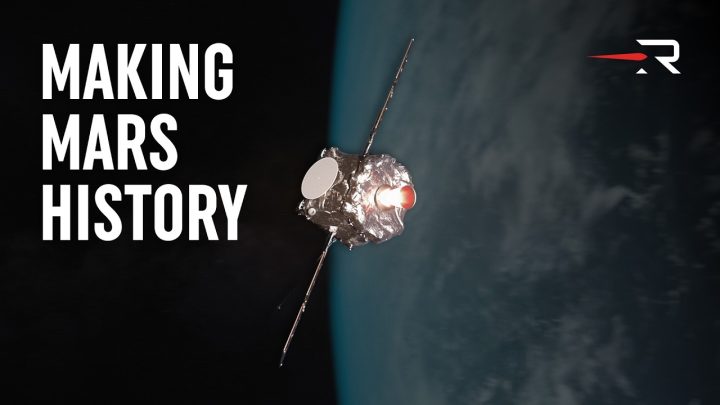
Thumnail credit: Mark Garlick / Science Photo Library / Getty Images / Roscosmos