Twenty-five years ago this week, the International Space Station was still a construction site, a handful of modules joined in orbit and visited by only a few crews. On October 23, 2001, a Soyuz spacecraft docked with that young station, the hatches opened, and the first person to float through was a French physician and astronaut named Claudie Haigneré. In that moment she became the first European woman to board the International Space Station, a first that ESA is marking again this October. She spent eight days aboard, running experiments and helping swap the station’s lifeboat spacecraft. The anniversary is worth more than nostalgia, because her flight explains how the station was actually built to work: one visiting crew, one fresh rescue ship, and one experiment programme at a time.
A Taxi Flight With a Serious Job
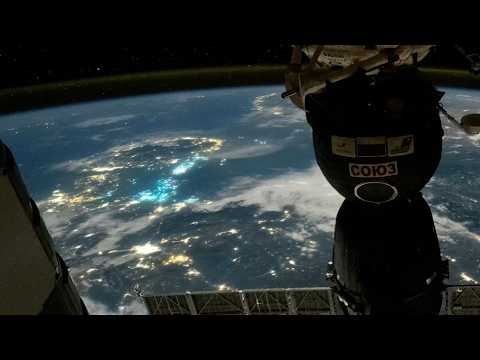
Haigneré’s mission, named Andromède, was what station planners called a taxi flight. A Soyuz docked to the ISS serves as the crew’s lifeboat, but a Soyuz is only certified to stay in orbit for about six months, so a fresh one must be delivered on schedule and the older one flown home. Haigneré launched from Baikonur on October 21, 2001 aboard Soyuz TM-33, alongside commander Victor Afanassiev and flight engineer Konstantin Kozeev, and docked two days later. She was the first non-Russian woman to fly in a Soyuz as flight engineer, trusted with systems work rather than carried as a passenger. After eight days aboard, the crew departed in the older Soyuz TM-32 and landed in Kazakhstan on October 31, completing the swap exactly as planned.
The First Through the Hatch
The docking itself was automatic, monitored closely by the crew, who were ready to take manual control if anything drifted. What followed was the choreography every visiting crew performs: leak checks, pressure equalisation between the two spacecraft, and a pause of about ninety minutes, one full orbit, before the hatches could open. When they did, at 14:16 Central European Summer Time, Haigneré entered first, officially becoming the first European woman aboard the station, watched by observers at the control centre near Moscow who included the French prime minister. Waiting to receive her was the Expedition Three crew, who had moved their own Soyuz to a neighbouring port days earlier to clear the way. Firsts in spaceflight are often about timing and assignment as much as talent, but somebody still has to be ready when the hatch opens. Haigneré, a veteran of a 1996 mission to the Mir station, was.
Eight Days of Work, Not Ceremony
A taxi flight lasts barely a week aboard, so its science programme is packed tight. The Andromède crew carried around 85 kilograms of experiments and worked across life sciences, biology, materials science, and Earth observation. Some of the experiments had been designed by schoolchildren and students in Europe, an early version of the station’s long tradition of flying classroom science. Haigneré’s own background shaped the programme: trained as a rheumatologist, with a doctorate in neurosciences, she had spent years on the scientific side of human spaceflight before she ever flew. She described the mission afterward as challenging and intensely fulfilling, and pointed to the station itself as the real story. Europe, she said, was playing a significant role in building a machine meant to anchor space-based science for decades, and her flight was one of the early proofs.
A Career That Kept Breaking Ground
Andromède was not Haigneré’s only first. Her 1996 Cassiopée mission made her a Mir veteran years before the ISS existed as more than drawings, and in July 1999 she became the first woman qualified as a Soyuz return commander, responsible for a three-person capsule during re-entry. She had been selected as a candidate astronaut by the French space agency CNES in 1985 and joined the European Astronaut Corps in 1999. Then, less than a year after landing from the ISS, she changed arenas entirely: in June 2002 she was appointed France’s Minister for Research and New Technologies. The path from rheumatology laboratory to Soyuz flight engineer to government minister has no real parallel in the astronaut corps, before or since. It is a reminder that the early station era drew on a generation of scientist-astronauts whose lives were as unusual as their missions.
Why This Anniversary Still Matters
The station Haigneré visited in 2001 is now nearing the end of its life, and the routines her flight helped establish, crew rotation by visiting spacecraft, lifeboat swaps, and short visiting missions packed with experiments, became the operating rhythm of the ISS for a quarter of a century. European astronauts now fly to the station as a matter of routine, one or two a year in the assembly era and regularly ever since, a normalcy that had to start somewhere. It started, for European women, with a Soyuz docking on October 23, 2001 and a doctor from Le Creusot floating first through the hatch. Twenty-five years on, the video ESA released this week is more than a history clip. It is the opening chapter of Europe’s human story on the station, and it still holds up.