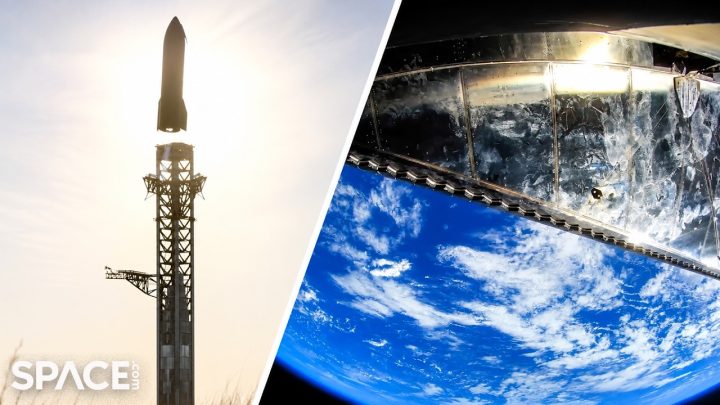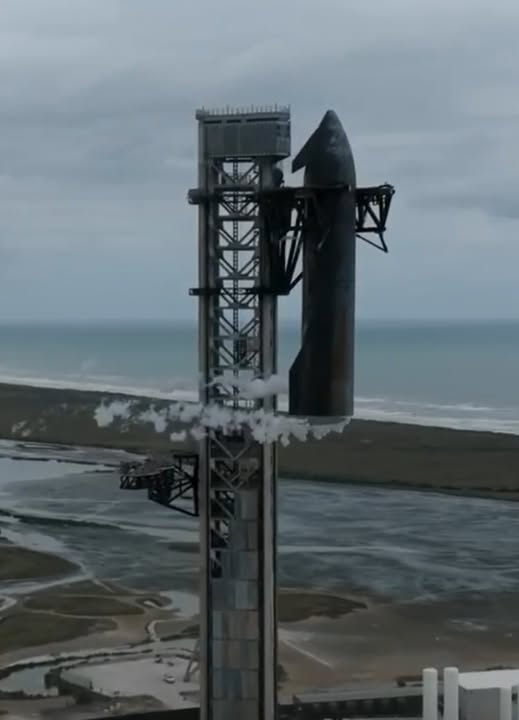
It did it. At about 4:20 PM Eastern on Saturday, November 14, 2026, the launch tower at Starbase, Texas reached out its arms and caught a returning Starship — Ship 42, falling out of the sky at the end of an orbital flight — and held it there, swaying gently above the Texas coast. For the first time in history, the upper stage of an orbital rocket has come home and been caught in mid-air by the tower it launched from.
Spaceflight changed today. Not incrementally, not on a roadmap slide — today, in full view of the world.
How the Catch Happened
Ship 42 lifted off Friday evening on Starship Flight 15, the fifteenth test flight of the two-stage Starship system and the fourth flight of the enlarged Starship V3. It deployed all 26 of its Starlink V3 satellites in orbit, then spent roughly a day circling the Earth while SpaceX prepared the return.
On Saturday afternoon the ship fired its deorbit burn at about 3:23 PM Eastern, survived a plasma-hot re-entry, and steered itself back to Starbase with astonishing precision. In the final seconds it swung upright beside the tower — and the tower’s “chopstick” arms closed around it. The booster half of the flight, Booster 22, had its own catch attempt called off on Friday because of a guidance issue and diverted to an offshore splashdown in the Gulf. That made Saturday’s ship catch the flight’s one shot at history. It nailed it.
Why This Is the Moment Everything Changes
SpaceX had already proven it could catch the giant Super Heavy booster. Impressive as that was, the booster is the easy half of the problem — it never reaches orbit. The ship is the spacecraft: it goes all the way to orbit, it carries the cargo and one day the crews, and until today no one had ever recovered one this way. A ship that splashes down in the ocean is a ship you fish out, inspect for salt-water damage, and rebuild. A ship hanging in the arms of its own launch tower is a ship you inspect, restack, refuel, and fly again.
That difference is the whole ballgame. Starship carries no landing legs — the tower catch is not a stunt, it is the design. Every kilogram not spent on legs and landing hardware is a kilogram of payload. And a vehicle that returns to the exact pad it left can be turned around in days instead of months, which is the difference between a rocket and an airline.
The Road From Here
Everything on SpaceX’s manifest depends on this working. The Artemis Moon program needs Starship tankers flying in quick succession to fill an orbital depot. The Mars plans need dozens of ships cycling like freight aircraft. Starlink’s biggest satellites need cheap, frequent, fully reusable lift. None of that arithmetic closes if the ship is thrown away or fished out of the sea after every flight.
On Saturday, hanging in the tower arms over Starbase with the Gulf of Mexico behind it, Ship 42 closed that arithmetic. The age of disposable spacecraft is ending. The age of the spaceship that comes home has begun.