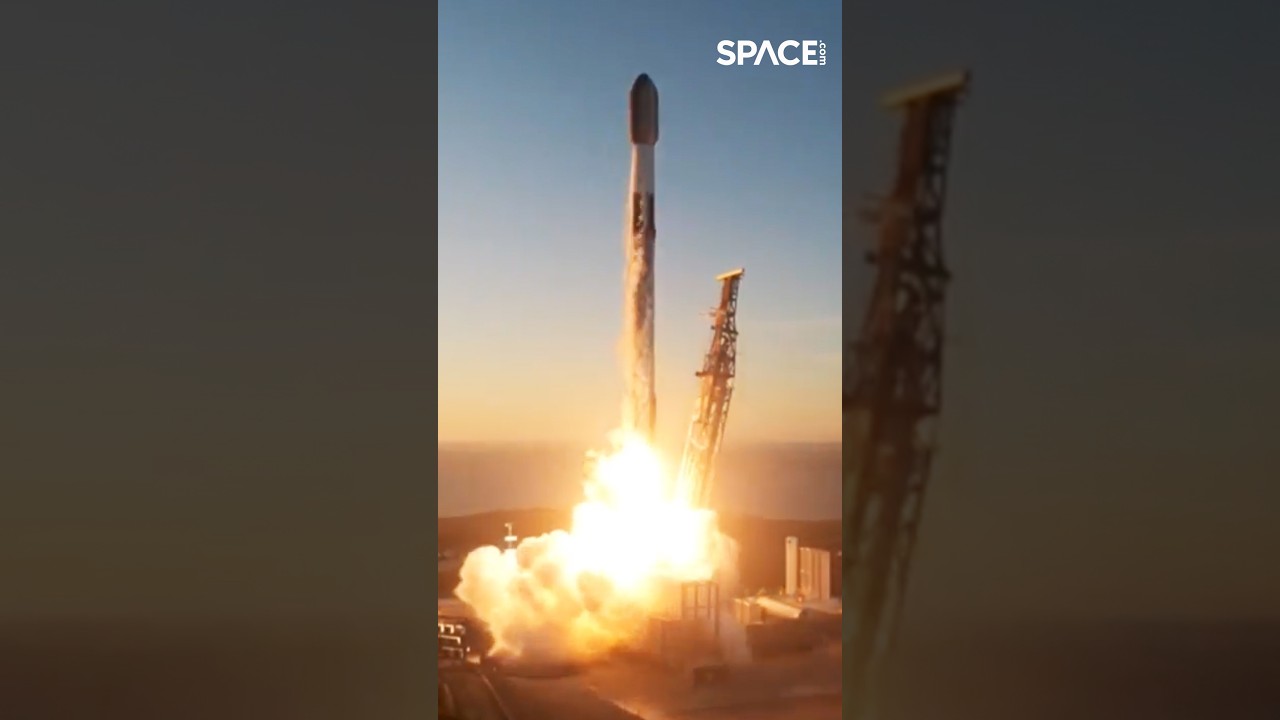
Some launches are announced with countdown clocks, crew introductions and months of publicity. USSF-432 was the opposite: a Falcon 9 lifting off into the California dusk on Friday evening, carrying a payload the United States Space Force declines to describe, on a mission whose name tells you almost nothing. The rocket rose from Space Launch Complex 4 East at Vandenberg Space Force Base at 00:48 UTC on Saturday, November 7 — 4:48 p.m. local time on Friday — inside a four-hour window that had opened just two minutes earlier. Minutes later, its first stage came back down through the marine layer and settled onto a droneship waiting in the Pacific. By every public measure, the secret mission was a complete success.
That combination — total openness about the rocket, total silence about the cargo — is now the defining rhythm of American national-security spaceflight. SpaceX webcasts the ascent, the stage separation and the booster landing for anyone in the world to watch live. What it will not show, or even name, is the spacecraft riding inside the fairing. The Space Force designates the flight USSF-432, launch trackers add the code name R-4, and beyond that the official record simply stops. For the growing constellation of classified payloads the United States is placing in low Earth orbit, that silence is not an oversight. It is the mission working as designed.
A Launch at Dusk From Vandenberg
Vandenberg, on California’s central coast in Santa Barbara County, is the natural home for missions like this one. Its pads point rockets south and southeast over open ocean, toward the polar and near-polar orbits that Earth-observation and sensing satellites prefer. Falcon 9 followed that familiar southeastern trajectory on Friday, climbing away from SLC-4E while most of the country was finishing its evening. The launch had slipped several times during the week — earlier targets on Monday and midweek gave way to the Friday window — which is unremarkable for a classified flight, where range availability, weather and hardware checks all compete quietly. When the window finally opened at 4:46 p.m. Pacific, SpaceX needed only two minutes of it.
The flight also kept a remarkable cadence intact. Launch trackers counted USSF-432 as roughly SpaceX’s 125th launch of 2026 and, by some tallies, the 702nd Falcon 9 flight overall — numbers that would have sounded implausible a decade ago. California had already broken its own annual launch record before November began. A classified Space Force mission has become routine enough to be one line in a very long manifest, and that routineness is itself a strategic fact: adversaries see a launch industry that can absorb secret payloads without slowing its commercial rhythm.
What Little Is Known About the Payload
Officially, almost nothing has been said about what USSF-432 carried. SpaceX published no payload description, no target altitude and no deployment details beyond confirming the mission for the U.S. Space Force and a destination in low Earth orbit. The Space Force, consistent with practice for this class of mission, added no colour of its own. Even the spacecraft’s owner within the service has not been identified. Anyone looking for a photograph of the satellite, a mass figure or an orbital inclination will find the same answer everywhere: not disclosed.
What analysis exists comes from the outside, from the small community of launch trackers who read drop zones, airspace warnings and trajectory data the way meteorologists read pressure charts. Their assessment, reported by several spaceflight outlets, is that USSF-432 most likely carried a batch of classified satellites built on SpaceX’s Starshield bus — the military sibling of Starlink — for the Space Force’s Space Based Sensing and Targeting portfolio. The southeastern trajectory and the hazard areas matched earlier Starlink-group profiles closely enough to support that reading. It remains an inference, not a confirmation, and it should be treated as one. But it fits the broader pattern of the United States building a proliferated layer of sensing satellites in low orbit, designed so that no single loss can blind it.
The Booster That Came Back
If the payload was new, the rocket was anything but. The first stage, tail number B1095, was flying for the eighth time, having previously launched a GPS III navigation satellite and six Starlink missions. Its last flight was more than six months ago, a reminder that even in SpaceX’s high-tempo operation, individual boosters rotate through inspection and refurbishment between assignments. National-security customers once demanded brand-new rockets for their most sensitive payloads. That era has quietly ended: a booster with seven flights behind it is now considered proven rather than risky, and the Space Force is content to fly classified cargo on reused hardware.
After stage separation, B1095 turned for home. About eight and a half minutes after liftoff it touched down on Of Course I Still Love You, SpaceX’s Pacific droneship, extending a landing streak that has made recovery look almost mundane. The droneship has now hosted well over two hundred successful landings, and each one feeds the economics that make this cadence possible. A recovered booster can be inspected, refurbished and flown again, spreading its cost across mission after mission. For a launch provider flying more than a hundred times a year, that arithmetic is not a bonus. It is the business model.
Why the Space Force Flies in Secret
It is fair to ask why a democracy launches satellites it will not describe. The answer lies in what sensing and targeting spacecraft do: they watch missile launches, track moving objects and feed targeting-quality data to commanders, and their exact capabilities determine what an adversary must hide from. Publishing a payload’s resolution, revisit rate or orbital plane would hand rival planners a manual for evading it. Classification, in this world, is not principally about hiding that a satellite exists — amateur trackers will find and catalogue it within days. It is about hiding precisely what it can see, and when.
USSF-432 also illustrates how thoroughly the work has shifted to commercial hands. The Space Force bought a launch service; SpaceX supplied the rocket, the range and the recovery fleet, and the boundary between a military mission and a commercial one was mostly a matter of which details appeared on the webcast. That model lets the service surge launches when it needs them, at prices shaped by commercial volume. Friday’s flight suggested both sides of that bargain are holding.
What Happens Next
For the payload, the public story effectively ends at fairing separation. The spacecraft will check out on orbit under Space Force control, join whatever constellation they belong to, and be tracked silently by the amateur networks that follow every classified launch. No announcement of operational status is expected. If the Starshield reading is right, they are now part of a sensing layer the United States intends to keep expanding, launch by launch.
For SpaceX, the next launch is never far away, and that is precisely the point this mission makes. A classified payload, a veteran booster, a dusk liftoff from Vandenberg and a droneship landing in the Pacific: every element of USSF-432 was, by 2026 standards, ordinary. The extraordinary part is that such a flight can be ordinary at all — that the world’s most secretive customer can book the world’s busiest rocket and be airborne two minutes into its window. Watch the video above, and you are watching the visible half of a mission designed to stay invisible. The other half is already on orbit, doing its work, saying nothing.