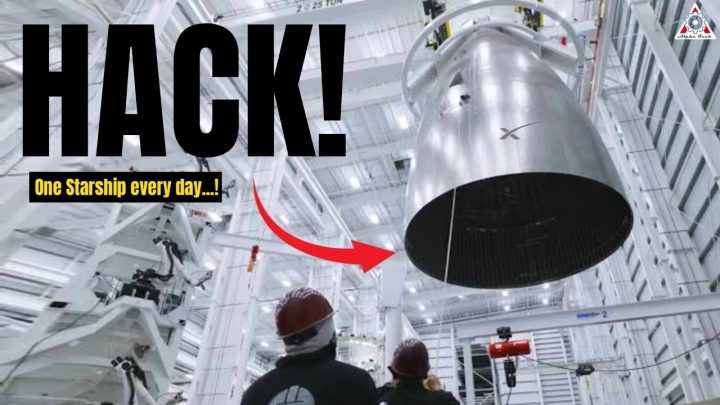
Most rocket engines are treated like works of art: built slowly, in small numbers, by specialists who expect each one to take months. SpaceX set out to treat its biggest engine like a product rolling off a car line. The result is the Raptor, the methane-burning engine that powers Starship, produced at a rate the rest of the rocket industry has never attempted. By November 2022 SpaceX was already building more than one Raptor a day, and the company designed its factories around going faster still. The secret is not a single breakthrough; it is a philosophy applied ruthlessly to every bolt.
That philosophy matters because Starship consumes engines the way other rockets consume money. A single Starship system uses 33 Raptor engines on the Super Heavy booster and six more on the ship itself, three optimised for sea level and three for vacuum. Lose a booster, and you have lost 33 engines in one afternoon. A vehicle designed to fly often, and eventually in fleets, cannot wait months for handcrafted replacements. SpaceX therefore had to solve the factory before it could truly solve the rocket.
An Engine Designed to Be Built, Not Just to Fly
Raptor burns liquid methane and liquid oxygen, a combination known as methalox, and uses a full-flow staged combustion cycle in which all of the propellant passes through pre-burners before reaching the main chamber. It is only the third engine in history designed around that cycle and the first such engine to power a vehicle in flight. The cycle is efficient and, in theory, easier on engine life because no fuel is thrown away to drive the pumps. It is also famously complicated, with two pre-burners and turbopumps handling enormous pressures. Choosing it meant SpaceX accepted a hard engine and then had to make that hard engine simple to manufacture.
The numbers show the direction of travel across three generations. Raptor 1 produced about 185 tonnes of thrust, weighed about 2,080 kilograms and ran at a chamber pressure near 250 bar. Raptor 2 raised thrust to about 230 tonnes while cutting mass to roughly 1,630 kilograms and raising pressure to about 300 bar. Raptor 3 reached about 280 tonnes of thrust at roughly 1,525 kilograms and pressures around 350 bar, giving it a thrust-to-weight ratio above 180. Each version was not merely stronger; it was cleaner, with fewer external parts to assemble, inspect and protect.
Simplification is where the speed comes from. Across the generations SpaceX replaced bolted flanges with welds, folded external plumbing into the body of the engine, and printed complex components additively instead of machining and joining many pieces. Raptor 3 integrated so much of its cooling and plumbing internally that it no longer needs the external heat shield earlier versions carried. Every removed part is one less thing to manufacture, stock, torque, test and replace. Multiplied across dozens of engines per vehicle and hundreds of engines per year, those small deletions become the production rate.
The Factory Is the Real Machine
SpaceX recognised early that a workshop culture could not feed a Starship programme, so it built dedicated production capacity. In July 2021 the company announced a second Raptor facility near its McGregor, Texas test site, intended to concentrate on serial production while California handled vacuum variants and experimental designs. The stated ambition for that site ran to 800 to 1,000 engines a year. Company planning at the time also spoke of producing engines in volumes of hundreds per year at costs below a quarter of a million dollars each. Whether or not every target is met on schedule, the intent is unmistakable: engines as inventory, not as bespoke commissions.
Testing is built into the same loop. McGregor’s test stands fire Raptors constantly, and SpaceX’s development method deliberately pushes engines until they fail, because a failure on a stand is data and a failure in flight is a disaster. Flight engines then benefit from hardware that has already been stressed beyond its planned envelope. Rapid iteration also means the design never quite freezes, which would horrify a traditional aerospace programme. SpaceX accepts configuration churn as the price of learning quickly, and manages it by building so many engines that improvements flow into the line continuously.
There is a cultural element as well, visible in how the company talks about production. Engineers are expected to question any part whose purpose cannot be justified, and the best part, in SpaceX’s oft-repeated phrase, is no part at all. Requirements inherited from earlier designs are treated as suspects rather than scripture. That attitude produced an engine that looks almost plain beside its predecessors, its complexity hidden inside cast and printed passages. Plain, in this case, is the point: an engine that looks simple is an engine a factory can repeat.
Why One Engine a Day Changes Everything
Production rate is strategy, not just logistics. At more than one engine a day, SpaceX can lose hardware in testing without losing its programme, a freedom traditional programmes spending years per engine simply do not have. It can stockpile engines ahead of flight campaigns, replace a suspect unit instead of repairing it in place, and keep multiple Starship vehicles in assembly at once. High rate also drives cost down the familiar manufacturing curve, as workers and machines repeat the same operations until they become routine. Routine is the unglamorous foundation on which reusable, high-cadence spaceflight has to rest.
The approach carries risks that should not be waved away. A design flaw in a mass-produced engine is also mass-produced, and Starship still has to prove the long, reliable service life that airline-style operations demand. Thrust records and factory tours do not by themselves demonstrate that Raptors can start, fly, land and fly again with minimal work, dozens of times over. SpaceX’s answer is the same as its production answer: fly often, inspect everything, and let the fleet generate the evidence. The factory makes that answer affordable, which is precisely why competitors study it so closely.
Viewed that way, the Raptor line is SpaceX’s real cheat code, and it is not cheating at all. Rivals built excellent engines and then discovered they could not build enough of them; SpaceX built the system that builds the engine, and let the engine improve inside it. The same logic now shapes Starship itself, assembled in factories designed for volume from the start. If Starship succeeds, historians may conclude that the decisive invention was never a nozzle, a pump or a propellant. It was a production rate, sustained day after day, until the extraordinary became ordinary.