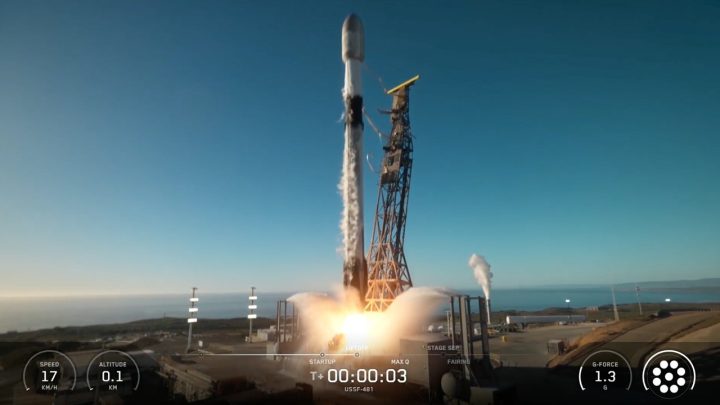
SpaceX launched a classified U.S. Space Force mission from California on Thursday evening, sending a Falcon 9 rocket skyward from Vandenberg Space Force Base with a payload the military will not describe. The mission, designated USSF-481, lifted off from Space Launch Complex 4 East at 5:01 p.m. Pacific time on October 15 (8:01 p.m. Eastern) on a southerly trajectory over the Pacific. It was the 114th Falcon 9 flight of the year, and it was carried by a first-stage booster flying for the 28th time — a veteran of crewed missions, NASA science flights, spy satellite launches and 16 Starlink missions. About eight minutes after liftoff, that booster touched down on the droneship Of Course I Still Love You stationed in the Pacific Ocean, and SpaceX's live webcast ended, as it always does for classified flights, the moment the landing was confirmed. What the rocket was carrying, where exactly it was going and what it will do once it gets there are all officially undisclosed. Spaceflight trackers believe the payload is headed for a high-inclination low-Earth orbit, and at least one analyst has speculated it could be a batch of Starshield satellites — the military version of SpaceX's commercial Starlink constellation — based on the first stage's drop zone. The Space Force has confirmed none of it. For the public, the record of USSF-481 will be the launch itself, the booster landing and one more line in the busiest year Vandenberg has ever seen. A Booster on Its 28th Flight The star of the evening, in a very real sense, was not the secret payload but the rocket that carried it. First-stage booster B1081 completed its 28th flight on the USSF-481 mission, extending a career that reads like a tour of the modern space age. Its previous 27 missions included Crew-7, which carried four astronauts to the International Space Station; CRS-29, a NASA cargo resupply flight; the PACE Earth-science mission; the EarthCARE climate satellite; the NROL-186 and NROL-48 national security launches; the TRACERS heliophysics mission; the COSMO-SkyMED Second Generation FM3 radar satellite; the earlier USSF-153 Space Force mission; Transporter-10 and Transporter-13 rideshares; and 16 dedicated Starlink flights. Only 35 days separated this flight from the booster's previous mission. That turnaround is the quiet miracle of the Falcon 9 program. A decade ago, the idea of flying the same orbital-class booster 28 times — including on a national security mission with a classified payload — would have sounded like science fiction. Today it is routine enough that SpaceX barely mentions it. The economics are transformative: each reuse spreads the cost of the booster across dozens of flights, which is precisely what allows the company to sustain a launch cadence that no…
SpaceX Falcon 9 rocket launches from California on classified U.S. Space Force mission
Source: Spaceflight Now
Keep exploring