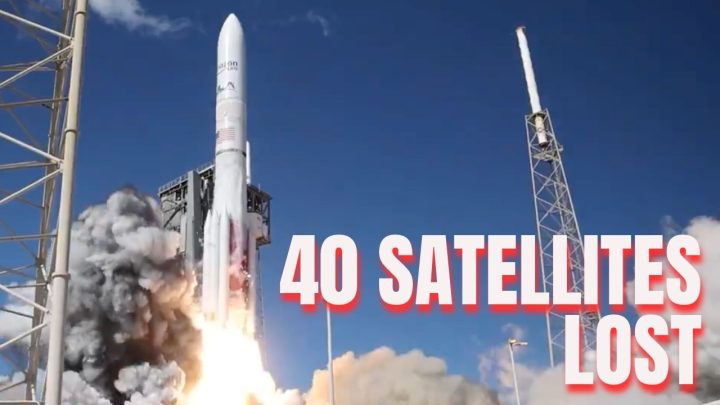
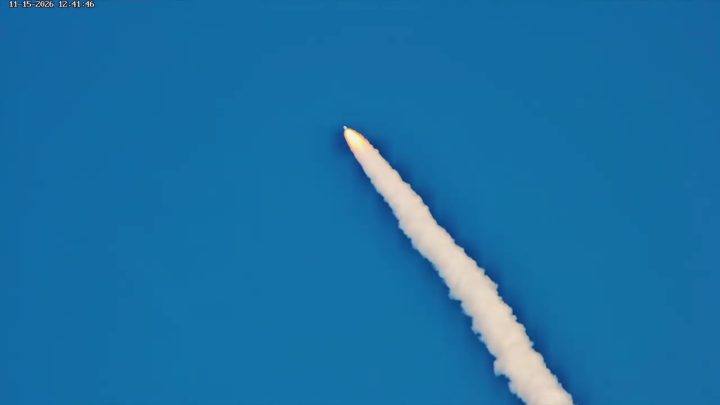
For twenty years, United Launch Alliance was the company that did not fail. That record ended on Sunday, November 15, when a Vulcan rocket lifted off from Cape Canaveral carrying forty satellites for Amazon’s Leo broadband network and never reached orbit. ULA confirmed that the vehicle suffered an anomaly about ten minutes into the flight and failed to deliver its payload, destroying the satellites and marking the first mission failure in the company’s history. The Boeing-Lockheed Martin joint venture, formed in 2006, had built its reputation on an unbroken string of successful missions for the Pentagon, NASA and commercial customers. The failure, reviewed in the Avid Space roundup above, now grounds the rocket that was supposed to carry much of America’s launch manifest — and much of Amazon’s challenge to Starlink.
A Flight That Looked Routine, Until It Wasn’t
Liftoff came at 12:40 p.m. Eastern on Sunday from Space Launch Complex 41 at Cape Canaveral Space Force Station in Florida. It was Vulcan’s fifth flight since its 2024 debut, its first in nine months, and the first to fly with six solid rocket boosters rather than two or four. The launch had been billed as a return to flight, after a hiatus drawn out by investigations into Vulcan’s solid rocket boosters and its core engines. On the webcast, however, the altitude readout was visibly failing to climb toward orbital height more than nine minutes into the flight. ULA ended the webcast and, at about 1:30 p.m., announced the anomaly and the loss of the mission.
The first reports placed the failure around the ten-minute mark, near the handover to the Centaur upper stage, and the initial statements were careful. “Based on data received by our Launch Director, we confirm that the Vulcan vehicle launched from Space Launch Complex 41 suffered an anomaly 10 minutes into the flight and failed to deliver the Amazon mission to orbit,” ULA said. The first stage had in fact burned roughly thirty seconds longer than planned, an early public clue that the core stage, not the upper stage, was where the energy went missing. A rocket that separates its first stage too low and too slow hands its upper stage a climb it cannot complete. That, in outline, is what ULA’s own investigation updates then confirmed.
The Trail Leads to the Fuel Feed, Not the Boosters
On Tuesday, November 17, ULA gave its first detailed account, and it moved the problem to the very start of the flight. “Early indications are that just after liftoff the launch vehicle experienced low booster performance, resulting in stage separation occurring when the vehicle was low in altitude and below minimal velocity to reach orbit,” the company said, using “booster” for Vulcan’s core first stage. The six Northrop Grumman solid rocket boosters — the components behind anomalies on two earlier Vulcan flights — appear to have performed normally, following nozzle improvements implemented for this launch. The Centaur upper stage also started normally, and its two RL10 engines operated as planned, but they could not make up the first stage’s shortfall. ULA stressed that it was early in the process and that it wanted to avoid speculation until the investigation is complete.
A further update on Wednesday, November 18, narrowed the trail again: preliminary findings indicate the first stage’s low thrust came from an inadequate fuel supply to its two BE-4 engines, not from the engines’ own performance. The distinction matters, because the BE-4s are built by Blue Origin, Jeff Bezos’s space company, and also power its New Glenn rocket; a vehicle-side fuel-feed fault keeps the suspicion on Vulcan’s own plumbing and systems rather than on the engine design. Blue Origin is working closely with ULA to determine the root cause, and ULA has not announced a final finding. The Federal Aviation Administration will oversee the ULA-led mishap investigation, be involved at every step, and must approve the final report, including any corrective actions, before Vulcan flies again.
A Record That Took Two Decades to Break
To understand why one lost payload is a landmark, it helps to remember what ULA was. The company was created in 2006 to consolidate America’s government launch business, and its Atlas V and Delta IV rockets compiled a mission-success record that became its entire sales pitch: expensive, conservative and reliable. Vulcan was built to replace both fleets, and its first four flights, whatever their blemishes, all delivered their payloads to orbit. Solid rocket booster malfunctions marred two of those flights, including a Space Force mission in February, but an anomaly survived is a different thing from a mission lost. Sunday’s flight crossed that line for the first time, and Reuters noted the failure is expected to lead to a lengthy technical investigation that would keep the rocket off the market for months.
What Grounds With Vulcan
The most exposed customer is Amazon. Sunday’s mission, designated Amazon Leo 1 on Vulcan, was the first of thirty-eight Vulcan missions Amazon has bought for Leo, its planned rival to SpaceX’s Starlink; Vulcan is slated to carry more than 1,500 of Amazon’s first-generation satellites, more than any other rocket in the program. It was ULA’s tenth launch for Leo overall, but the previous nine flew on the retiring Atlas V, so the constellation’s Vulcan era has begun with a total loss of forty satellites joining a network of nearly four hundred already in orbit. Amazon must now wait on an investigation it does not control for the rocket carrying the largest share of its deployment plan. Every month of delay is a month in which Starlink’s head start grows.
The Pentagon is exposed too: Vulcan holds contracts for roughly half of all United States national security launches, and its manifest includes Space Force and intelligence missions that cannot simply move to another provider on short notice. NASA also has a stake, since the Centaur V upper stage is integral to future flights supporting the Artemis programme’s Space Launch System. ULA says it understands the impact on its customers and is committed to returning to flight as safely and quickly as it can. In that order, most observers expect: the company’s twenty-year record was built on never hurrying, and its first failure will be answered the same way. What Sunday changed is the sentence every future Vulcan pitch must now survive — ULA has failed once, and everyone in the market knows it.