A day after SpaceX caught a Starship upper stage with the tower for the first time, Elon Musk laid out what comes next — and it is not a small stretch. Starship V4, the next version of the ship, will be about 70 metres long on its own. That is the upper stage alone, without the Super Heavy booster underneath it.
To put that in perspective, an entire Falcon 9 rocket with a Crew Dragon capsule on top is also 70 metres tall. In other words, the V4 ship by itself will stand as tall as the complete rocket that has carried astronauts to the International Space Station for years. What used to be a whole launch system will now be just the top half of one.
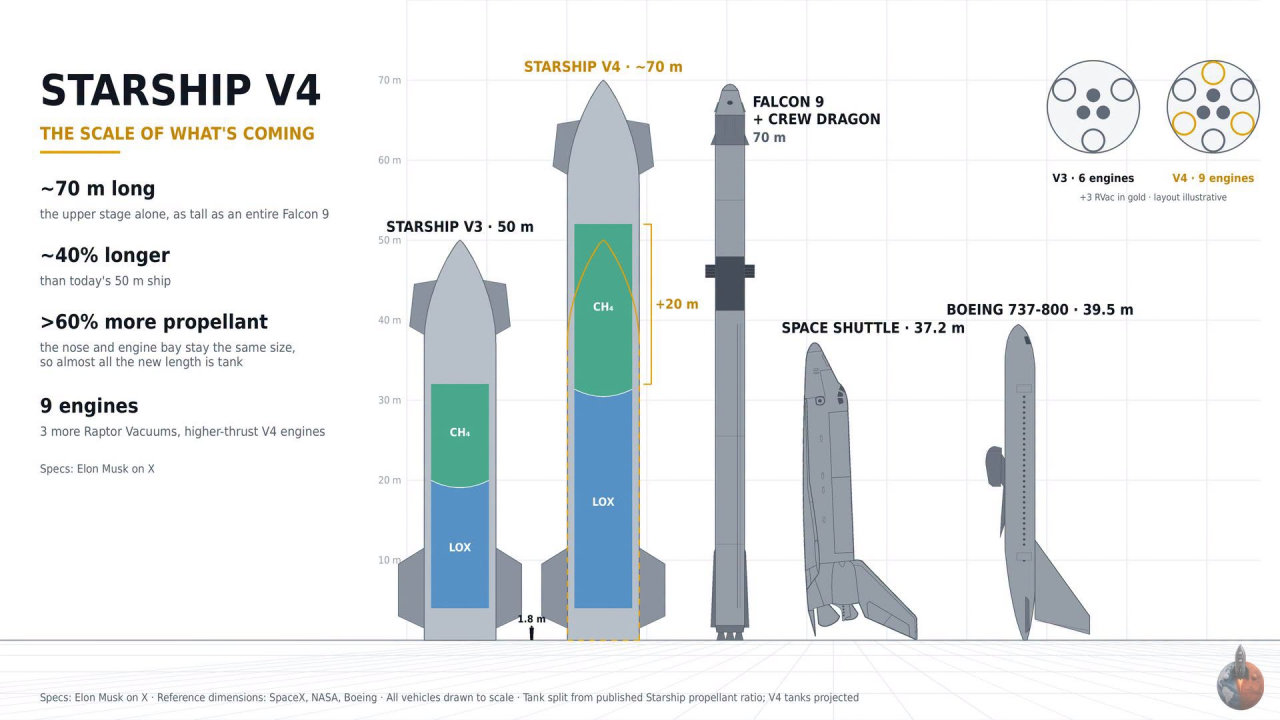
Musk posted the numbers on X on Sunday evening, November 15: “Starship V4 will be ~70m long, which is roughly a 40% length increase and allows >60% more propellant load. Engine count will be raised to 9, with 3 more Raptor-Vacuum engines added, and these will be higher thrust V4 engines.”
From 50 Metres to 70 Metres in One Generation
Today’s ship, Starship V3, is about 50 metres long in the scale graphic — other published figures put the flying V3 ship closer to 52 metres. Either way, V4 adds roughly 20 metres, a jump of about 40 percent in a single generation. Rockets normally grow by a metre or two at a time. Twenty metres is a redesign.
That extra length does not go into a bigger nose cone or a larger crew cabin. As the graphic shows, the nose and the engine bay stay much the same size. Almost all of the new length is propellant tank — a much longer methane (CH4) tank on top of a much longer liquid oxygen (LOX) tank.
The diameter does not change. V4 stays 9 metres wide, the same as V1, V2 and V3. SpaceX is not building a wider ship, it is building a far longer one, which is why the vehicle can grow so much without a completely new factory, transporter or launch mount.
Stack that 70-metre ship on a Super Heavy booster and the full vehicle gets taller still. The current V3 stack stands about 124.4 metres. Projections for a V4 stack put it around 142 metres, which would make it by far the tallest rocket ever flown — well clear of Saturn V at 110.6 metres and NASA’s SLS at about 98 metres.
More Than 60 Percent More Propellant
Length is only the headline. The reason for the stretch is what it does to the tanks. Musk says V4 will carry more than 60 percent more propellant than V3, and that number matters more than the height.
The V3 ship carries about 1,600 tonnes of liquid methane and liquid oxygen. Sixty percent more points to roughly 2,560 tonnes or more in the V4 ship alone — a projection from Musk’s percentage, not a published SpaceX tank figure yet. That is more propellant in the upper stage alone than many complete rockets weigh at liftoff.
More propellant means more energy once the ship is already in space. That is what pays for heavier payloads to orbit, for the long burns needed to leave Earth orbit, and for the tanker flights that will have to refuel a lunar or Mars ship before it can go anywhere. A bigger tank is not just a bigger rocket — it is range.
Musk has tied that growth directly to payload. SpaceX expects V3 to deliver about 100 metric tons to orbit in reusable form. For V4 and later generations, the company has talked about reaching 200 tons, and Musk added in the same series of posts that payload will exceed 200 tons while propellant cost per flight drops below $500,000. Those are targets, not demonstrated performance, but they show the direction: double the payload for less fuel cost per flight than a small rocket costs to fuel today.
Nine Engines, Double the Vacuum Raptors
The back of the ship changes as much as the middle. V3 flies with six Raptor engines: three sea-level Raptors in the centre for use in the atmosphere and for landing, and three Raptor Vacuum engines around them, with much larger nozzles optimised for the vacuum of space.
V4 goes to nine engines. The three sea-level engines stay at three, and the vacuum count doubles from three to six. All nine will be higher-thrust V4-generation Raptors, so the ship gets both more engines and stronger engines at the same time.
Doubling the vacuum engines matters most away from Earth. In space there is no air pressure pushing back on the exhaust, so a vacuum Raptor can expand its plume much further and extract more push from the same propellant. Six of them give the ship far more thrust for orbit-raising, translunar injection and the other long burns a 70-metre tanker or depot ship will be asked to do.
It also gives the ship more margin. Flight 15 and earlier V3 flights have already shown SpaceX shutting down a Raptor Vacuum in flight and still reaching its target by burning the others longer. With six vacuum engines instead of three, losing one is a smaller fraction of the ship’s total space thrust.
How V4 Compares to Everything Else
The scale in the graphic is worth slowing down for, because 70 metres is hard to picture until it stands next to familiar machines. The Space Shuttle orbiter — the winged vehicle itself, not the full stack — was 37.2 metres long. A V4 ship is almost twice that length, at about 1.9 Shuttles nose to tail.
A Boeing 737-800, the airliner millions of people fly on every week, is 39.5 metres long. V4 is about 30 metres longer than that jet — roughly another three-quarters of a 737 added on top. Park a V4 ship on a runway and it would tower over the airliner beside it, even though one flies between cities and the other is designed to leave the planet.
Against people, the scale is almost absurd. The human figure at the base of the graphic is 1.8 metres tall. It would take about 39 people standing on each other’s heads to reach the tip of a V4 ship. The ship is also about 23 storeys tall if you count roughly three metres per floor — a high-rise building that happens to fly.
Other landmarks help too. The copper Statue of Liberty, without her pedestal, is about 46 metres — V4 is half again as tall. The Leaning Tower of Pisa is about 57 metres — V4 clears it by more than 10 metres. Even the full Saturn V comparison flips with V4: the Apollo rocket was a complete system at 110.6 metres, while V4 reaches 70 metres before its booster is even counted.
Why SpaceX Wants a Ship This Big
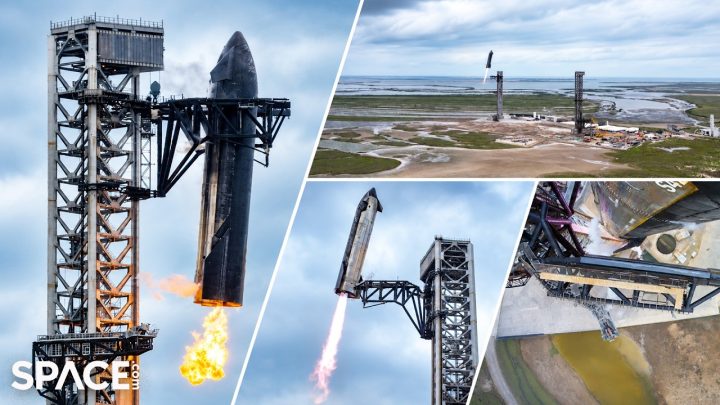
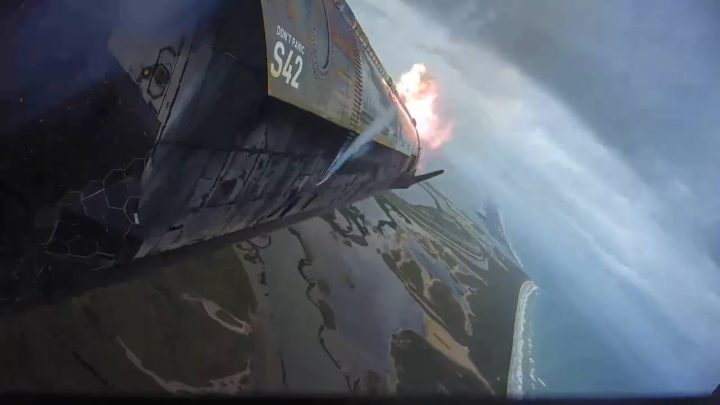
Musk first talked about a longer, nine-engine V4 back in August 2025, with a first flight targeted for 2027. Sunday’s post is the most specific he has been, and the timing is not accidental. It came a day after Ship 42, a V3 ship, was caught by the Starbase tower on Flight 15 after deploying 26 Starlink V3 satellites — the first tower catch of an upper stage.
In SpaceX’s plan, a ship this large is not mainly about setting height records. A 200-ton-class ship changes the maths for everything downstream: far fewer tanker flights to fill a depot for one Moon mission, far more Starlink satellites per launch, and a single vehicle that can act as ship, tanker and cargo hauler with the same basic hull. That is why almost all the growth went into tanks rather than payload bay glamour.
There are still open questions the graphic is honest about. Its tank split is drawn from the published Starship propellant ratio and the V4 tanks are projected, not measured from finished hardware. The engine layout diagram is labelled illustrative, and no V4 ship has been stacked, let alone flown. Everything Musk posted is a specification for what’s coming, not a report on what has already been built.
Even with those caveats, the direction is clear. V3 proved SpaceX could catch the ship it already has. V4 is the ship SpaceX says it actually wants for the Moon and Mars work ahead: 70 metres long, nine engines, more than 60 percent more propellant, and, on its own, as tall as the entire Falcon 9 system that built SpaceX’s reputation.