NASA is preparing to drop three helicopters into the sky over Mars and let each one fly itself down to the surface. The mission is called SkyFall, and it was announced on March 24, 2026, as part of the agency’s Ignition event. Instead of arriving tucked inside a rover or sitting on top of a lander, the three aircraft will be released in mid-air from an entry capsule about 1,000 metres above the ground. Each helicopter will then power up, stabilise itself and descend under its own control to a separate landing spot. It is a bold way to arrive on another planet, and it grows directly out of one of NASA’s most popular successes.
That success was Ingenuity, the small helicopter that rode to Mars with the Perseverance rover in 2021. Ingenuity was only meant to prove that powered flight was possible in the thin Martian air, with five flights planned at most. Instead it flew 72 times over nearly three years, scouting ahead of the rover and photographing terrain no wheeled vehicle could reach easily. A damaged rotor finally ended its mission, but by then the argument was settled. Aircraft belong in the Mars toolkit, and SkyFall is the mission designed to turn a demonstration into a working fleet.
From One Demonstration Helicopter to a Team of Three
The SkyFall helicopters are bigger, heavier and far better equipped than their famous predecessor. Each aircraft stands about 52 centimetres tall, weighs about 5 kilograms and carries two counter-rotating rotor blades about 1.35 metres across. Ingenuity, by comparison, weighed less than 2 kilograms and carried no science instruments at all. SkyFall’s machines are built to do real science work from the air and from the ground between flights. NASA’s Jet Propulsion Laboratory is developing them with AeroVironment, the Virginia company whose engineers also helped design and build Ingenuity.
Working as a team of three is the other big change from the Ingenuity era. A single helicopter can scout a single neighbourhood, but three aircraft can spread out across a region and compare what they find. They can map different kinds of terrain in parallel, revisit promising spots and keep working if one machine runs into trouble. They also do not need a rover to speak for them. Each SkyFall helicopter is designed to send its data directly to spacecraft orbiting Mars, using an ultra-light radio developed to free rotorcraft from dependence on a surface relay.
The Mid-Air Drop That Gives the Mission Its Name
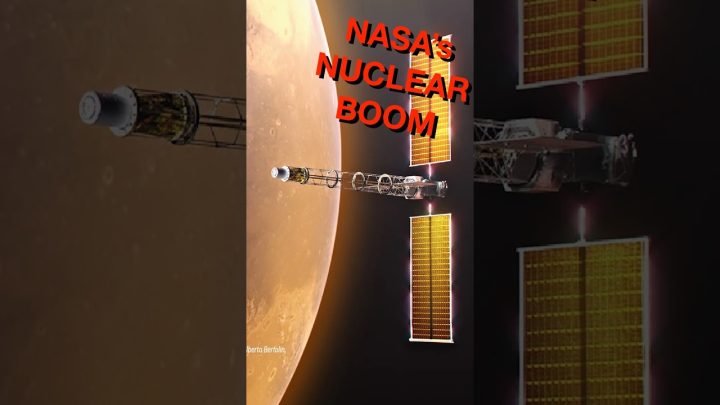
The arrival sequence is the part of SkyFall most likely to be replayed when the day comes. The helicopters will travel to Mars inside an entry capsule carried by SR-1 Freedom, a spacecraft using nuclear fission propulsion for the interplanetary journey. After a cruise phase and an initial Mars flyby in 2029, the capsule will make its final approach and release the three helicopters in the fall of 2030. The aircraft will drop, start their rotors and fly down through thin air that offers very little lift. Engineers have already pushed the new rotor design hard in Mars simulation chambers, taking the blade tips beyond Mach 1 in testing.
Skipping the lander is more than a stunt, because it changes the economics of sending aircraft to Mars. A traditional landing system has to be designed around the payload it sets down, and every extra kilogram of structure is a kilogram that cannot be science. A capsule that simply releases self-landing helicopters can, in principle, deliver aircraft to places a large lander could not safely go. Planners are targeting arrival in the northern hemisphere in spring, on routes chosen to avoid the worst of the dust storm season. Landing site workshops are planned for early and late 2027 to pick terrain that is both scientifically rich and flyable.
Hunting for Ice Hidden Under the Dust
The main scientific job is to find and map water ice buried just below the Martian surface. Each helicopter carries optical cameras working in visible and near-infrared light, a ground-penetrating radar, temperature sensors and a radiation monitor. The radar can read the upper three metres of crust, and deeper in ideal conditions, telling apart layered dust, rock and ice. Those layers are a record of how Mars changed from a warmer, wetter world into the frozen desert seen today. Knowing exactly where accessible ice sits is also practical knowledge, because future human crews will need water they do not have to bring from Earth.
The flight plan is built for coverage rather than short hops. The helicopters are expected to travel one to two kilometres on each flight day, working every other Martian day, for total journeys of roughly 200 to 300 kilometres over the mission. That is a completely different scale from Ingenuity, whose flights were measured in hundreds of metres. The baseline mission lasts about six months, with the usual hope that healthy hardware earns an extension. In a technique NASA calls Balloon Mode, the aircraft can even drift with the wind to sample the atmosphere without carrying a dedicated wind sensor.
Scouts for the Humans Who May Follow
SkyFall sits at the meeting point of science and exploration planning. Its maps of subsurface ice, radiation readings and close-up views of candidate landing terrain are exactly the information mission planners need before committing astronauts to a site. Rovers are superb laboratories, but they move slowly and can be stopped by terrain a helicopter simply flies over. A fleet of rotorcraft can check several candidate areas in the time a rover checks one. That scouting role is why the mission description emphasises aerial mapping of potential landing sites alongside the ice hunt.
The timeline is long, as Mars timelines always are, with launch targeted for late 2028 and the landing still years beyond that. Much has to go right, from the nuclear-powered cruise to a first-of-its-kind mid-air deployment in another planet’s atmosphere. Yet the lineage is reassuring, because almost every element grows out of hardware or lessons Ingenuity already proved in flight. When the animation in the video above shows three small aircraft falling out of a capsule and flying away over Mars, it is not science fiction. It is a flight plan, with dates, instruments and a landing season attached.