Can the United States land astronauts on the Moon in 2028 — and beat China there? That is the question NASA Administrator Jared Isaacman takes on in the conversation above with Space.com’s Chelsea Gohd, and his answer is neither a guarantee nor a hedge. Isaacman argues that NASA is finally on a more achievable path: a restructured Artemis campaign that flies at least once a year, tests everything that can be tested in Earth orbit in 2027, and then sends a crew to the lunar south pole in 2028. The public response to Artemis II, the crewed flight around the Moon earlier this year, convinced him the country is ready to sustain that pace. What he will not promise is that the race is already won.
The stakes, as Isaacman frames them, extend well beyond exploration bragging rights. China has stated its intention to land its own astronauts on the Moon before 2030, and its programme has spent two decades methodically ticking off every prerequisite — space stations, lunar orbiters, landers, rovers and sample returns from both the near and far sides of the Moon. In Isaacman’s telling, whoever reaches the south pole first gains more than a flag-planting moment. The pole’s shadowed craters hold water ice that can become drinking water, oxygen and even rocket propellant, making the region the natural training ground for Mars.
A Programme Rebuilt Around Cadence
The central problem Isaacman inherited was time — specifically, the gaps between flights. NASA’s Artemis I uncrewed test flew in November 2022, and Artemis II did not follow until April 1, 2026, a gap of 1,232 days, or nearly three and a half years. Isaacman’s answer is cadence: a commitment to launch Artemis missions at least annually, with more than twenty crewed and uncrewed moon-base missions planned in the campaign ahead. “If the Chinese beat us back to the Moon, I’ll be fired,” he told Florida Today in October — a line he delivered as accountability, not bravado.
The restructured plan also swaps grand architecture for a surface base. Development of the Gateway lunar space station has been paused indefinitely, and the resources are being redirected toward a surface moon base near the south pole expected to cost more than $20 billion. Isaacman describes the polar region — an area roughly the size of Washington, D.C. — as the critical terrain of the new race. China and Russia are planning their own lunar base ambitions, including a nuclear-powered installation within a decade. In the administrator’s framing, NASA is a national-security mission as much as a scientific one: doing near-impossible things, visibly and first, is the message.
Artemis III: The Dress Rehearsal in Earth Orbit
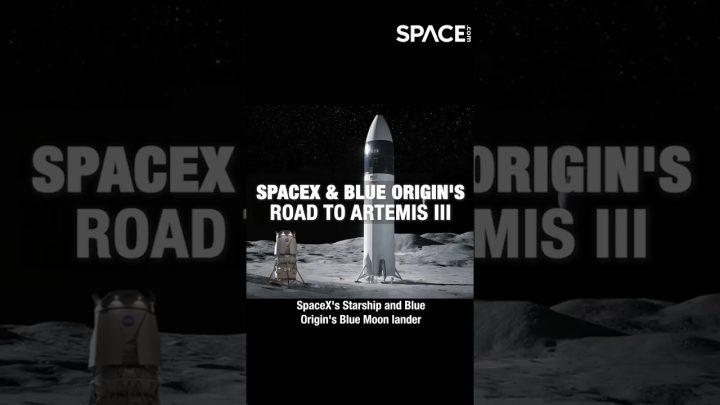
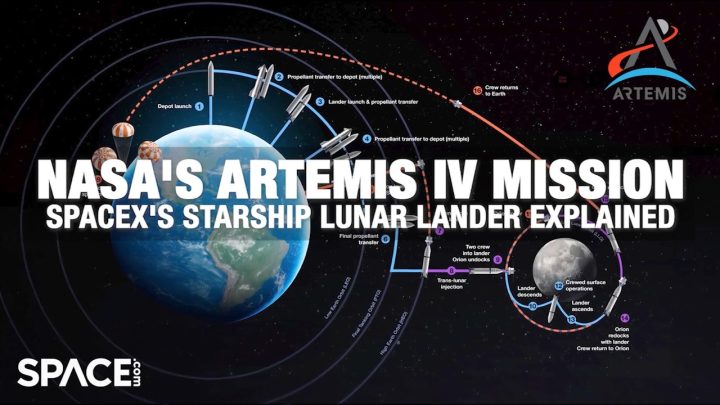
The hinge of the whole plan is Artemis III, now targeted for the summer of 2027 — but it is not the landing mission its name once implied. Under the revised architecture, four astronauts will lift off aboard Orion atop the 322-foot Space Launch System and spend roughly 14 to 17 days in low Earth orbit. There, Orion will rendezvous and dock with the two commercial Human Landing Systems in development: SpaceX’s Starship and Blue Origin’s Blue Moon. The crew will exercise the landers’ systems, test interoperability between vehicles built by rival companies, and rehearse the operations a landing crew will depend on. Only after that dress rehearsal does Artemis IV attempt the surface, in 2028.
It is an unusually honest piece of programme design, and Isaacman’s team has been candid about why it exists. At NASA’s October update at Kennedy Space Center, officials described what the programme had gotten right, what it had gotten wrong, and how assembly and integration schedules at Kennedy have been cut roughly in half. Hardware for Artemis III is coming together at the Cape, with a tanking test targeted for the end of the year. Preserving two landing partners, rather than betting on one, is deliberate: it gives Artemis IV optionality, so the 2028 date does not live or die on a single contractor’s readiness. The approach concedes that neither lander is ready today — and builds the schedule around proving them before a crew’s life depends on them.
The Other Side of the Race
What makes the contest genuinely close is how recently the gap was supposed to be unbridgeable. Isaacman likes to remind audiences that China achieved its first solo human spaceflight — its “John Glenn moment” — only in 2003, by which point NASA had landed on the Moon six times and flown 113 Space Shuttle missions. In the 23 years since, China has deployed hundreds of satellites, built a permanently crewed space station, landed autonomous spacecraft and rovers on the Moon, and returned samples from the far side, a first in history. Beijing is assembling a credible two-launch architecture for a crewed landing, and Isaacman has said publicly that a Chinese landing in 2029 or 2030 is “very achievable.” He takes, in his words, the implications of coming up short very seriously.
The fear is not simply losing a race, but losing position. Isaacman argues that the first crew to operate at the south pole shapes the norms, infrastructure and practical access that follow — “first come, first served,” as he put it in October. A Chinese base established first could, in his assessment, complicate American operations in the very environment NASA needs as its Mars rehearsal space. Even so, the timeline pressure is real on both sides: China’s lander, crew vehicle and rocket are all in testing, and its 2030 deadline is public and politically owned.
What Has to Go Right by 2028
For NASA’s date to hold, a demanding chain of events must fire in sequence. Artemis III must fly in 2027 and prove Orion’s docking and life-support operations with both landers, without a major anomaly that forces a redesign cycle. SpaceX must demonstrate Starship’s orbital refuelling — a dozen or more tanker flights for a single landing — while Blue Origin matures its own cryogenic lander and transfer vehicle. New lunar spacesuits must be ready, launch processing at Kennedy must sustain the new cadence, and funding must survive successive congressional budgets. Any single long delay compresses a 2028 landing window against a Chinese programme that has built its reputation on hitting announced dates.
Isaacman’s wager is that urgency, honestly stated, is itself a management tool. By saying out loud that China may land by 2029, that his own job rides on the outcome, and that Artemis III exists to find problems before they can kill a crew, he is trying to give NASA the Apollo-era pressure without the Apollo-era pretence that the schedule is safe. The Moon race of the 2020s will not be decided by speeches, his included. It will be decided by whether the rockets, landers and suits in Florida and Texas are ready before the ones in Wenchang and Beijing. For the first time in half a century, that is a genuinely open question — and 2028 is when we start to learn the answer.