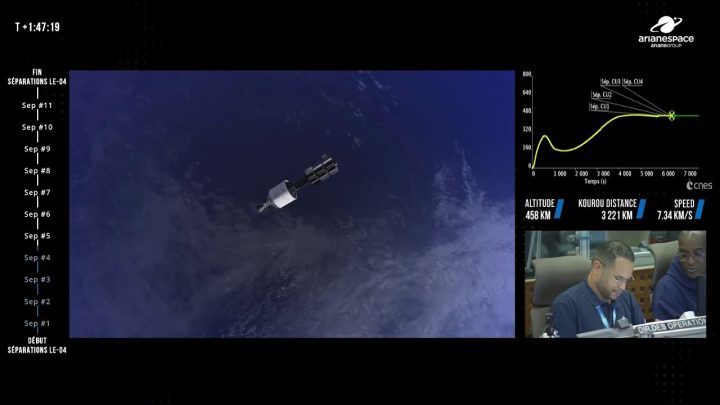
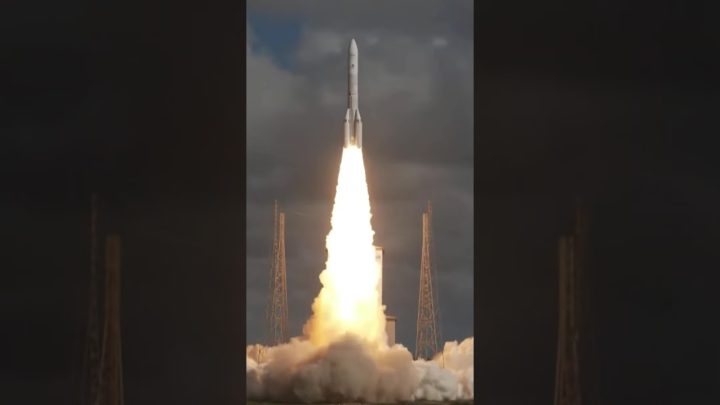
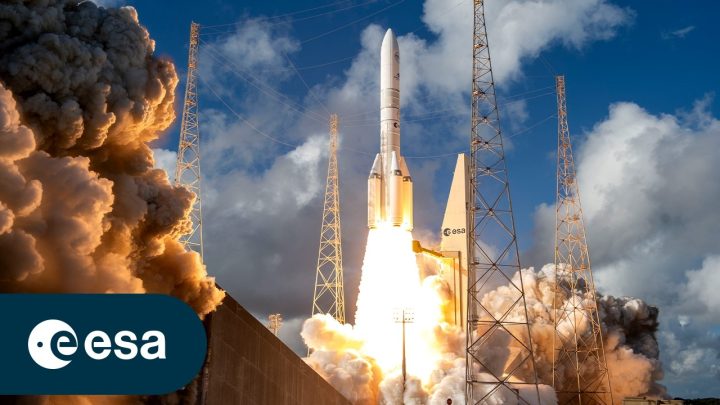
Arianespace’s powerful Ariane 6 rocket launched from Europe’s Spaceport in Kourou, French Guiana, on Nov. 24, 2026, carrying 36 Amazon Leo broadband internet satellites into low Earth orbit. The VA271 mission, also known as Amazon Leo LE-04, had a launch window that opened at 5:45 a.m. EST (1045 GMT). The flight was a further step in the steady build-up of Amazon’s satellite internet constellation, and it came one day later than first planned. The launch had originally been scheduled for Nov. 23, but it was postponed following a technical issue involving ground support systems. Teams carried out the necessary checks and analysis before clearing the rocket for its flight on Nov. 24.
The mission marks the 10th flight of Ariane 6 and its fourth launch for Amazon Leo in 2026, which makes it an important marker for both Arianespace and Amazon. Flying in its Ariane 64 configuration with four solid rocket boosters, the European rocket is supporting the deployment of Amazon’s growing satellite internet constellation. Each launch of this kind adds a further batch of satellites to a network that is designed to deliver broadband from low Earth orbit. For Europe, the flight also demonstrated that Ariane 6 is now operating as a regular launcher, rather than as a new vehicle still proving itself. For Amazon, it was another routine step in a programme that depends on a high launch rate.
What happened on launch day
The launch took place from Europe’s Spaceport in Kourou, on the north-east coast of South America, where Ariane rockets have flown for decades. The site gives launchers a clear path over the Atlantic, and it remains the main base for Europe’s heavy-lift missions. On Nov. 24, Ariane 6 lifted off in its Ariane 64 form, using four solid rocket boosters alongside its main stage to carry the 36 Amazon Leo satellites to orbit. The VA271 designation identifies this as the latest flight in Arianespace’s launch sequence, while the name Amazon Leo LE-04 identifies it as the fourth Amazon Leo mission in the current series. Together, those names show how a single flight can belong to two stories at once: the story of a rocket family, and the story of a constellation.
The one-day delay is also part of the story, because it shows how launch teams handle a problem that is found close to lift-off. A technical issue involving ground support systems stopped the Nov. 23 attempt, and the launch was held while teams carried out the necessary analyses. That kind of pause is common in spaceflight, and it is often the safest choice when the issue is on the ground rather than in the rocket itself. A ground system can be inspected, repaired and tested again without the pressure of a rocket already in flight. The successful launch on Nov. 24 therefore reflects not only the performance of Ariane 6, but also the work of the teams who cleared the issue and returned the vehicle to the pad.
Ariane 64 and the Amazon Leo constellation
Ariane 64 is the most powerful version of Ariane 6, and it is the version used when a mission needs the greatest lift. The four solid rocket boosters give the rocket extra thrust at lift-off, which allows it to carry a heavier payload or a larger group of satellites. For a mission such as VA271, that capacity matters, because 36 satellites must be carried together and then released into low Earth orbit. The satellites are designed to work as part of a wider network, rather than as single spacecraft, so each launch adds capacity to a system that only becomes useful once many satellites are in place. Amazon Leo is being built in exactly that way, flight by flight, with each mission adding another layer to the constellation.
Why Europe’s heavy launcher matters
Ariane 6 is the successor to Ariane 5, and it was developed to give Europe independent and affordable access to space for a wide range of missions. Its tenth flight is therefore a milestone in its own right, because it shows that the rocket has moved beyond its first test flights and into regular service. A launcher reaches that point only when it can fly repeatedly, carry different kinds of payloads, and return to the pad after a delay without a long pause. VA271 meets all of those tests: it was a commercial mission, it carried a large satellite batch, and it flew a day after a ground-system issue. For Arianespace, that record supports its case that Ariane 6 can serve both institutional customers, such as the European Space Agency, and commercial customers, such as Amazon.
What comes next for Amazon Leo
Amazon Leo is one of the largest satellite internet projects now under way, and it is being built to compete in a market that is already served by other large constellations. Its success will depend on how quickly Amazon can place enough satellites in orbit, and on how well the network performs once it is in service. Launches such as VA271 are therefore only one part of the programme, alongside satellite production, ground stations and the terminals that customers will use. The fact that this was Amazon Leo’s fourth launch on Ariane 6 in 2026 shows how much of that work is now being done through European launches. It also shows why Amazon has spread its launches across several providers, because no single rocket family can carry the whole constellation on its own.
The Nov. 24 launch will be judged in the end by the same simple test as any satellite mission: whether the 36 satellites reached their planned orbit and began working as part of the constellation. The flight’s wider meaning, however, lies in what it says about Ariane 6 and Amazon Leo together. Ariane 6 has now flown ten times, and it has carried Amazon Leo satellites on four of its flights in 2026 alone. That partnership is helping to build a new broadband network in low Earth orbit, and it is giving Europe’s heavy launcher a steady stream of commercial work. If that pace continues, VA271 will be remembered not as a single launch, but as one more step in the rapid build-up of a constellation that is changing how the internet reaches people around the world.
Credit: Arianespace / ESA