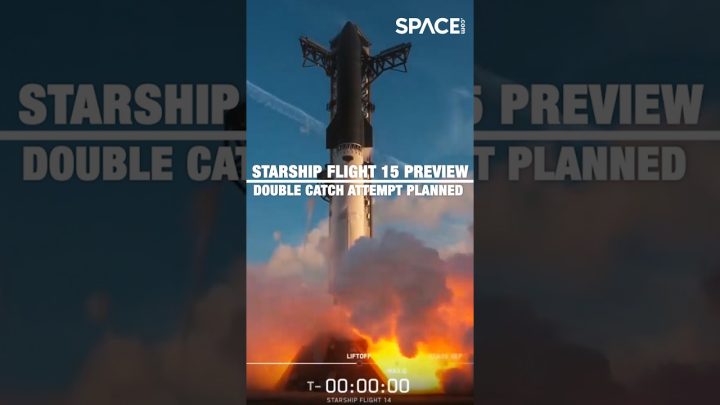
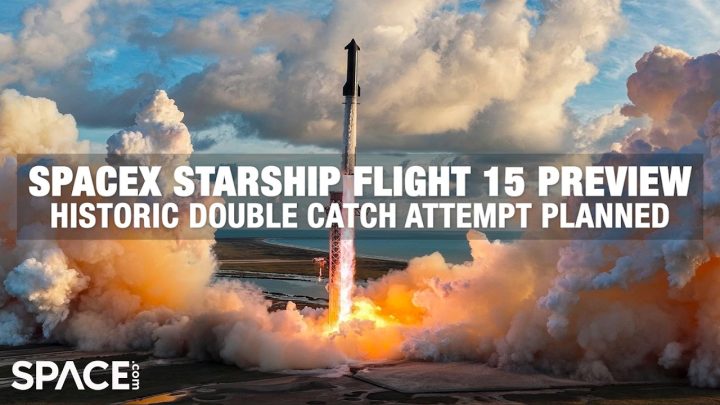
The ground shook at Starbase on Sunday morning, and the next era of the Starship program took a measurable step closer. At 8:22 a.m. Central time on October 25, SpaceX ignited all 33 Raptor engines on the Super Heavy booster assigned to Starship Flight 15, holding the giant first stage on Pad 2 for a full-duration static fire. The booster, designated Booster 22, is the bottom half of the most ambitious test flight SpaceX has yet attempted. Late that same night, in a detail easy to miss, the launch tower lifted the booster off the pad entirely — a rehearsal, observers believe, for the catch the company intends to perform when this vehicle comes home.
A static fire is the moment a rocket proves it can be a rocket. The vehicle is fueled, the countdown runs, and the engines light — but hold-downs keep it on the ground while engineers record thrust, temperature, pressure, and vibration from every engine. Thirty-three engines must light together and burn as one machine; a single fault can force an abort and a long recycle. Booster 22’s clean, full-length burn therefore clears one of the biggest single gates between Starbase and a November launch window.
The Other Half: Ship 42 Takes Its Turn
The booster was not the only hardware moving this week. On Monday, the 171-foot upper stage assigned to the same flight — Ship 42 — rolled out to SpaceX’s Massey’s test site, where it conducted a single-engine static fire at 9:17 p.m. Central time, according to NASASpaceflight observers tracking the site around the clock. Ship 42’s path to the pad has been more winding than its partner’s: at one point all six of its engines were removed before another round of cryogenic proof testing. Once its own checks are complete, it returns for engine installation and, ultimately, stacking on top of Booster 22.
That choreography matters because Flight 15 is not just another test. It will be the fourth flight of the enlarged Starship V3 configuration, following a Flight 14 in late September that reached orbit, deployed a batch of next-generation Starlink satellites too large to fly on Falcon 9, and still splashed down in controlled fashion in the Pacific despite an early upper-stage engine shutdown. Each V3 flight is being asked to prove more than the last. Flight 15 is being asked to prove the hardest thing of all: bringing both stages home to the same tower they left from.
The Double Catch: The Plan That Defines Flight 15
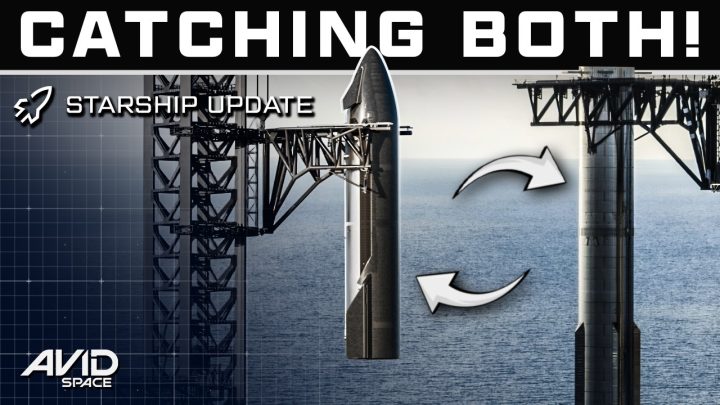
Here is the headline act, stated plainly by the company’s leadership. During SpaceX’s October 20 earnings call, Elon Musk announced that Flight 15 will attempt to catch both the Super Heavy booster and the Starship upper stage with the launch tower’s giant mechanical arms — the “chopsticks.” Musk said he believes success is “more likely than not,” while noting the company remains hardware-rich if the attempts fail. Company president Gwynne Shotwell has said SpaceX expects its FAA license for the flight to authorize return-to-launch-site catches for both vehicles, after what she called significant constructive engagement with regulators.
The booster half of that plan is proven technology, at least in SpaceX terms. The company has caught a returning Super Heavy three times, beginning with Flight 5 in October 2024, when the arms first plucked a falling booster out of the air in an image that circled the world. The ship half is entirely new: no Starship upper stage has ever been caught, or even attempted. A returning ship must fly back over land — including northern Mexico — to reach the Texas tower, which is precisely the regulatory hurdle Shotwell described. Sunday night’s quiet lift of Booster 22 by the tower arms suggests the choreography is being practiced on the ground long before it is attempted at terminal velocity.
Why Catching the Ship Changes Everything
Catching rockets is not a stunt; it is the economic core of the entire Starship design. A booster or ship that lands in the ocean, or even on a distant pad, must be transported, inspected, and refurbished before it can fly again. A vehicle caught by its own launch tower is, in principle, already where it needs to be: it can be lowered onto the mount, checked, restacked, and readied for another flight with a fraction of the handling. That is the path from rockets as expendable machines to rockets as aircraft — the comparison Musk himself uses. Every catch SpaceX pulls off is a direct down payment on the flight rate the company keeps promising.
And the promised flight rate is extraordinary. SpaceX is targeting a weekly Starship cadence in the first half of 2027 and twice-weekly flights in the second half, with a first reflight of a recovered upper stage planned early next year. Beyond that sits the long-delayed Starship-to-Starship refueling demonstration, also targeted for early 2027 — a capability NASA’s Artemis program depends on, because the lunar Starship variant must be refueled in orbit before it can carry astronauts to the Moon’s surface. None of that schedule survives contact with reality unless recovery becomes routine. Flight 15’s catches, if they work, are the hinge on which all of it swings.
What Happens Between Now and Launch
No official launch date has been announced. Unofficial air-traffic planning information has pointed to a window no earlier than November 8, and the pace of testing — booster fired, ship firing, tower rehearsing catches — is consistent with a flight in November rather than December. Still on the checklist: Ship 42’s remaining tests and engine work, the stacking of the full vehicle at Pad 2, a wet dress rehearsal or final integrated checks, and the amended FAA license covering both return profiles. SpaceX’s recent history says the schedule will be driven by hardware readiness, not by the calendar.
For now, the verdict of the weekend is simple. The most powerful rocket ever flown has fired its first stage cleanly, its upper stage is deep in testing, and its launch tower has already practiced holding the booster it hopes soon to catch out of the sky. When Booster 22 and Ship 42 finally rise together, they will be flying a mission profile no rocket has ever completed. If the chopsticks close around both of them on the way back down, Flight 15 will be remembered as the moment Starship stopped being an experiment in flying — and became an experiment in flying again.