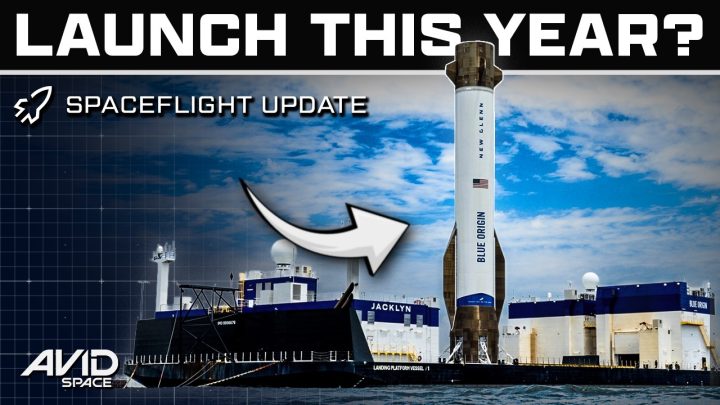
Blue Origin is still recovering from the explosion that destroyed its New Glenn rocket and its Florida launch pad in May, but the company is using the rebuild to aim far higher than a simple return to flight. While crews work toward resuming launches by the end of 2026, teams across the company are building infrastructure designed to transform New Glenn from an occasional flyer into a high-cadence workhorse. The stated goal is striking: multiple launches per week by the end of the decade. It is a plan that would have sounded ambitious before the accident. Coming out of the wreckage of one, it is a statement of intent about where Jeff Bezos’s rocket company believes the launch industry is heading.
The scale of the ambition is easiest to see in the paperwork. Blue Origin has asked the Federal Aviation Administration to raise the permitted New Glenn launch rate at Launch Complex 36 from 12 flights a year to 50. A draft environmental assessment released by the FAA in late September examines what that would mean: up to 100 static-fire engine tests a year, up to 50 first-stage booster landings on ocean platforms, payload fairing recoveries and regular temporary airspace closures. Regulatory approval is only the first gate, but without it, nothing else in the plan can happen.
Rebuilding From the May Explosion
The starting point for all of this is a crater. On May 28, 2026, a static-fire test at Launch Complex 36A ended in a massive explosion that destroyed the launch pad and wrecked the New Glenn rocket mounted on it. The accident grounded the company’s heavy-lift program and left Blue Origin with a choice every rocket company dreads: rebuild what was lost, or redesign for what comes next. Blue Origin chose the second option, treating the reconstruction of LC-36A as an opportunity to build a pad suited to a much faster operating tempo.
The rebuild is visibly underway. CEO Dave Limp, speaking at a space-industry panel at the company’s Rocket Park facility on Merritt Island in late September, said hundreds of people are working at the pad to get it ready to launch again. “We still think we have a path to launch this year,” Limp said, pointing to progress on the rebuilt vehicle access tower, whose first module has been placed, with added floors, guard rails, cryogenic control skids and environmental control piping following behind it. Structural steel on the east side of the launch table is complete, and the pad’s 480-volt power infrastructure has been energized. Each of those details is mundane on its own; together they describe a pad coming back to life on a deadline.
Two Pads, Two Rockets
A single pad cannot support multiple launches a week, and Blue Origin’s plans reflect that arithmetic. LC-36A, now being rebuilt, serves the current New Glenn 7×2 configuration. Alongside it, LC-36B is under construction to support the larger New Glenn 9×4 variant, which flies with nine BE-4 engines on its first stage and four BE-3U engines on its upper stage. Having two pads means one rocket can be prepared while another launches, removing the bottleneck that has historically limited launch cadence for every operator.
The company says it will go further still. In announcements this month, Blue Origin confirmed it plans additional new launch pads on Florida’s Space Coast, modeled on the LC-36 facilities, though it has not disclosed their exact locations. Senior Vice President of Operations Ian Richardson framed the build-out plainly: “These investments are centered on one goal: building the capacity to support more missions, more reliably, and more efficiently.” The infrastructure, he said, “is designed to support multiple flights per week by the end of the decade.”
The Ground Game Behind the Cadence
Launch pads are only half the equation; rockets and payloads have to be built, integrated and processed at the same pace. Blue Origin says its manufacturing and operations footprint has more than doubled in the last couple of years, now spanning more than 20 sites across Brevard and Orange counties. Richardson notes the company manufactures, launches and refurbishes rockets on the Space Coast, a claim no competitor currently matches in one place. That vertical integration is meant to keep the whole cycle — build, fly, recover, refurbish, fly again — inside one local industrial ecosystem.
The payload side is getting the same treatment. A customer integration facility is under construction in partnership with the U.S. Space Force at Cape Canaveral, with four payload bays, two encapsulation bays and an area for preparing missions carrying multiple payloads. Processing several spacecraft in parallel matters, because a rocket waiting on a late satellite is a launch slot lost. A new vertical integration facility for the 9×4 variant is also rising, giving the larger rocket its own assembly capacity rather than forcing it to share with the 7×2. Every one of these buildings is a bet that the constraint on future launch rates will be ground infrastructure, not demand.
The Regulatory Road Ahead
None of this flies without permission, and the FAA process will be closely watched. The draft environmental assessment for the 12-to-50 increase runs to 68 pages and examines noise, biological resources, historic properties, energy use, health and safety, and aviation emissions. Public and agency review of assessments like this can surface concerns — from sonic booms and road closures to effects on wildlife refuges near the Cape — that shape the final license. Blue Origin’s longer-term vision, multiple launches per week, would require still more approvals beyond this one, tied to the additional pads it has yet to site publicly.
There is also competition for the same sky. Last year, well over a hundred orbital rockets launched from Cape Canaveral and Kennedy Space Center combined, with SpaceX accounting for nearly all of them. Limp has argued the Cape is heading toward an airport-like future: “Today we might see 100 flights come out of the Cape a year. But this is going to go to 1,000. And it’s going to go to 10,000.” If he is even partly right, the range itself — its airspace, its sea lanes, its scheduling — becomes a shared resource that every operator’s plans depend on.
What Success Would Mean
For Blue Origin, cadence is credibility. New Glenn entered service years behind its original schedule, and the company has high-profile commitments — from commercial constellation deployments to national security missions and lunar ambitions — that all depend on flying often and reliably. A rocket that flies a handful of times a year is a science project; a rocket that flies weekly is a business. The May explosion could have pushed the company into a cautious crouch. Instead, it has answered with the largest infrastructure expansion in its history.
The proof, as always in this industry, will be flight hardware leaving the pad. The milestones to watch are concrete: LC-36A returning to service, the first New Glenn launch of the comeback campaign before the end of 2026, LC-36B’s completion for the 9×4, and the FAA’s decision on the 50-launch license. If those pieces fall into place, the Space Coast’s second heavy-lift operator stops being a footnote to SpaceX’s dominance and becomes a genuine second engine of American launch capacity. That is the future Blue Origin is building toward — multiple times a week, starting from a rebuilt pad and a rocket program that refused to stay down.