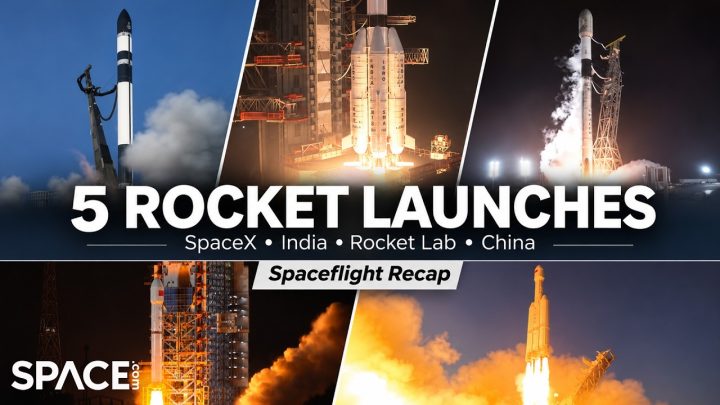
India’s space agency ISRO launched its GSLV-F18 rocket carrying the next-generation NVS-03 navigation satellite from the Satish Dhawan Space Centre in Sriharikota on October 30, 2026, lifting off at 11:51 p.m. India time, right on the targeted minute. ISRO declared the mission a success shortly after midnight, confirming that the rocket had placed NVS-03 in its intended orbit. It was the twentieth flight of India’s Geosynchronous Satellite Launch Vehicle, and it carried more weight than a routine satellite delivery. NavIC, India’s home-grown alternative to GPS, has been operating below the minimum number of satellites it needs. This launch was about closing that gap.
A Night Launch That Went Exactly to Plan
The 50-metre, three-stage rocket rose from the Second Launch Pad at Sriharikota, ISRO’s coastal spaceport in Andhra Pradesh, at 2:21 p.m. Eastern time, which was late evening in India. About half an hour after liftoff, ISRO announced on social media that GSLV-F18 had successfully placed NVS-03 in the intended orbit. The satellite separated into an elliptical geosynchronous transfer orbit, the standard stepping stone for spacecraft heading to geostationary altitude. From there, NVS-03 will use its own propulsion to raise and circularise its orbit over the coming days. Only after that orbit-raising and a period of in-orbit testing will the satellite join the working navigation fleet.
Precision mattered on this flight because the transfer orbit leaves little room for improvisation later. Reporting based on ISRO’s mission brochure put the planned orbit at roughly 170 kilometres at its lowest point and more than 37,000 kilometres at its highest, tilted at about 20.75 degrees. The achieved orbit was reported as very close to those targets, which is what mission controllers want to see. A clean injection means the satellite spends less of its own fuel correcting the rocket’s work. That fuel margin translates directly into years of operational life once the satellite settles into its final slot.
Why NavIC Needed This Satellite So Badly
NavIC, short for Navigation with Indian Constellation, is India’s regional satellite navigation system, designed to provide positioning and timing over India and an area extending roughly 1,500 kilometres beyond its borders. It is a strategic asset as much as a civilian one, giving India navigation services that do not depend on a foreign system in a crisis. The constellation was designed around seven satellites, but ageing first-generation spacecraft have thinned the fleet over time. In a written reply to Parliament on July 29, Space Minister Jitendra Singh disclosed that only three satellites were providing navigation services. He also stated that at least four are required for basic positioning, meaning the system could not offer standalone positioning even though its timing services remained functional.
That admission is what made NVS-03 one of ISRO’s most consequential launches of the year. Once the new satellite is commissioned, the operational fleet rises from three to four, an increase of a third, and the system reaches its stated minimum for positioning. It does not complete the constellation, which would still be three spacecraft short of the seven-satellite design. Further NVS-series launches will be needed to restore full depth and redundancy. But moving from below the minimum to at it is the difference between a system that cannot do its core job alone and one that can.
A Second-Generation Satellite With New Signals
NVS-03 is the third spacecraft in India’s second-generation NVS series, built to sustain and upgrade the original IRNSS fleet that NavIC grew out of. The satellite has a lift-off mass of roughly 2,250 kilograms and is built on ISRO’s proven I-2K bus, a workhorse platform used across Indian communications and navigation missions. It broadcasts navigation signals in the L1, L5 and S bands, including the L1 signal that helps make NavIC services accessible to a wider range of commercial devices. Second-generation satellites were also designed with longer service lives and improved clocks compared with the first generation. Each replacement therefore does more than restore a number; it modernises the service the remaining fleet can offer.
The satellite’s journey is not finished just because the rocket’s part went well. NVS-03 must fire its own engine in a series of manoeuvres to climb from the transfer orbit to its final geostationary position. It must then deploy, stabilise and begin broadcasting test signals that ground stations can evaluate. ISRO has not announced a firm date for the satellite to enter navigation service. That commissioning phase is where seemingly successful launches occasionally falter, so officials will be watching the next several weeks closely.
The Rocket, Its Record and a Point to Prove
The GSLV is India’s medium-lift vehicle for delivering heavier satellites toward geostationary orbit, a job its smaller PSLV sibling cannot do. The programme has had a chequered history, and Indian reporting on this flight tallied the vehicle’s record at twenty missions with fourteen successes, four failures and two partial failures. Early GSLV flights struggled with India’s indigenous cryogenic upper stage, the most technically demanding part of the rocket. The vehicle has matured considerably since those early years, but every flight still carries the programme’s reputation with it. A textbook F18 mission therefore counts as both a satellite delivery and a reliability statement.
There was an additional shadow over this launch: the previous NVS mission. NVS-02, launched in early 2025, reached orbit but failed to raise itself to its assigned position after a propulsion problem, and it never entered proper navigation service. An ISRO review published in February 2026 identified a disconnected connector in the drive signal to an oxidiser-line pyro valve as the most likely cause, affecting both primary and redundant paths. Findings like that tend to produce painstaking procedural changes rather than dramatic redesigns. The clean early performance of NVS-03 suggests those lessons were applied, although final judgement waits on the satellite completing its own climb.
What Happens Next for Indian Navigation
In the short term, attention stays on NVS-03 itself: orbit-raising burns, health checks and the first navigation signals from the new spacecraft. If commissioning goes smoothly, NavIC users should regain standalone positioning backed by the minimum four-satellite fleet. In the longer term, ISRO still has to launch the remaining second-generation satellites to rebuild the constellation to its full seven-spacecraft design. Each additional satellite improves accuracy, availability and resilience against the failure of any single spacecraft. India’s experience with NVS-02 showed how quickly a thin constellation can be weakened by one bad outcome.
Regionally, a healthy NavIC strengthens India’s hand in everything from aviation and shipping to disaster response and defence planning. It also keeps India in the small club of nations and blocs operating their own navigation constellations, alongside the United States, Russia, China and the European Union. For a launch that lasted only minutes late on a Friday night, GSLV-F18 carried an outsized amount of that ambition. The rocket did its part flawlessly. Now the satellite has to do the rest.