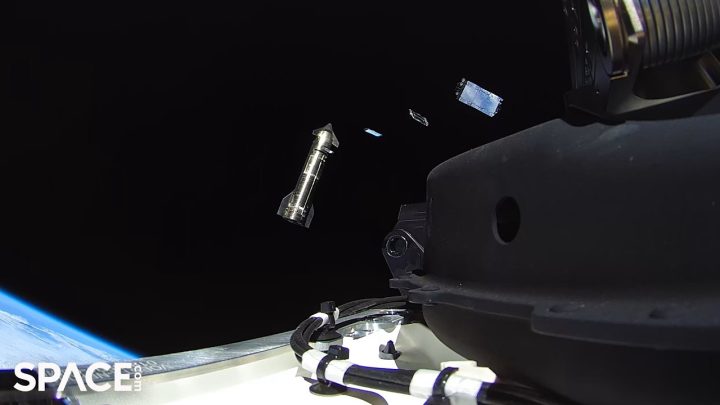
SpaceX launched the Starlink 10-50 mission from Cape Canaveral Space Force Station on a unique type of rideshare mission. Onboard the Falcon 9 rocket’s first stage booster, tail number B1090, were two specialized canisters from the Washington D.C.-based company Besxar. The company calls these 'Clipper-class' canisters that are precursors to the fully developed Fabships, which will be able to fly on a variety of rockets, including Starship. Besxar Flight-1, nicknamed 'Mission Asimov', carried onboard GaN-on-sapphire, undoped silicon, and bare sapphire wafer samples from Besxar, in addition to gallium arsenide (GaAs), and aluminum indium arsenide antimonide (AlInAsSb) wafers from academic research partners at the University of Virginia (UVA) and the University of Texas at Austin (UT Austin). This was the first of a dozen flights that Besxar booked on SpaceX Falcon 9 rockets carrying Starlink satellites. Spaceflight Now Reporter Will Robinson-Smith spoke with Besxar CEO and Founder Ashley Pilipiszyn to learn about the company, it's goals with Besxar Flight-1, and what the next 11 missions will need to accomplish on the road to fully functional Fabships. Launch video shot by: • Adam Bernstein, Spaceflight Now • John Pisani, Spaceflight Now Additional photos and video:
Besxar flies 1st semiconductor manufacturing spacecraft on SpaceX Falcon 9 rocket booster
Source: Spaceflight Now
Keep exploring